
Drawing / Withdrawing
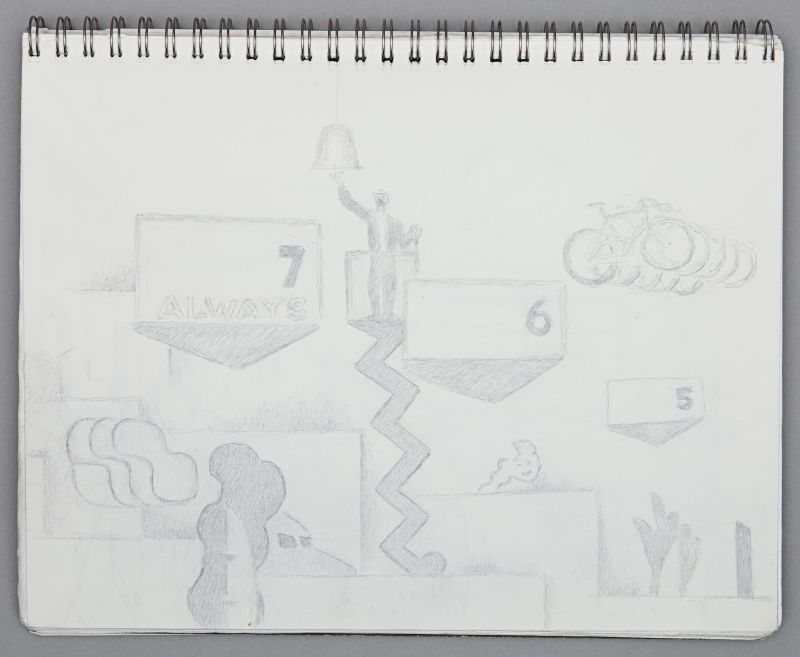
David Byrd’s America is a strange one. Teetering between observation and imagination, memory and hallucination, it feels at times like a muted surrealist fever dream, rendered softly in graphite. In Byrd’s world, the familiar is made unfamiliar: grocery aisle markers hover impossibly above a stepped highway corridor as an eighteen-wheeler crawls through a landscape adrift with abstract shapes and ambiguous silhouettes. Bicycles multiply and ascend, weightless and directionless. Center stage stands a masked lift operator, a spectral figure caught mid-task, changing the bulb of a lamp that dangles improbably from the sky itself. Soft, shadowed forms and fragmented faces punctuate this otherworldly composition, haunting the edges like half-remembered figures from a dream. Byrd’s vision of America is a place where the mundane and the mythic intermingle, and where the line between what is remembered and what is imagined begins to blur. For Byrd, the American landscape is not just a setting, but is also a psychological terrain—a reimagined American pastoral that is at once interior and institutional.
David Byrd (1926–2013) was an artist who lived on the margins in nearly every sense: geographically, professionally, and psychologically. Born in 1926 in Springfield, Illinois, and raised in a series of foster homes, Byrd spent the last quarter-century of his life working in near-isolation, in his self-built home studio tucked away in the rural Catskills of upstate New York. It was here, in the quiet foothills of Sidney Center, that he developed a singular body of work—at times haunting, sometimes humorous, but always deeply observant, and which remained almost entirely unknown until the final months of his life. His obscurity was shaped in part by a life spent working jobs that existed far from the established centers of art-world influence. After serving in the Merchant Marines during World War II, Byrd moved across New York, taking on a series of transient jobs that included delivering packages, janitorial work, ushering at cinemas, and, for a time, tending bars at a Coney Island resort.1 In 1958, he began working at the Veterans Administration hospital in Montrose, New York, where he would spend the next thirty years employed as an orderly in the psychiatric ward.2 This was a world few artists chose to witness, let alone make the focal point of their work: a world of trauma, disassociation, and quiet routine—lives of those living on the margins of society. His paintings and drawings from this time reflect a deeply attentive, almost voyeuristic sensibility—an impulse to observe, with remarkable patience and sensitivity, the daily rituals of those living on the periphery: patients lining up for meals, seated in waiting rooms, bathing themselves, or lost in states of mental drift. Byrd observed without judgment, rendering these figures with a sensitivity that borders on the empathetic, even as it retains a certain distance and forensic stillness.
When Byrd moved to the Catskills in the late 1980s, this impulse to observe and catalog daily life did not wane; instead, it simply shifted its focus to the daily rituals and unremarkable rhythms of small-town American life—a landscape of laundromats, grocery stores, auctions houses, and leisurely activities. In this pastoral setting, Byrd's longstanding preoccupations—with alienation, silence, and withdrawal—persisted, albeit in a softer, more diffused register. The institutional gave way to the rural, but the boundary between the two remained porous. His retreat into the secluded hamlet of Sidney Center, coupled with his detachment from the commercial art world, presaged the sense of estrangement that defines his work.
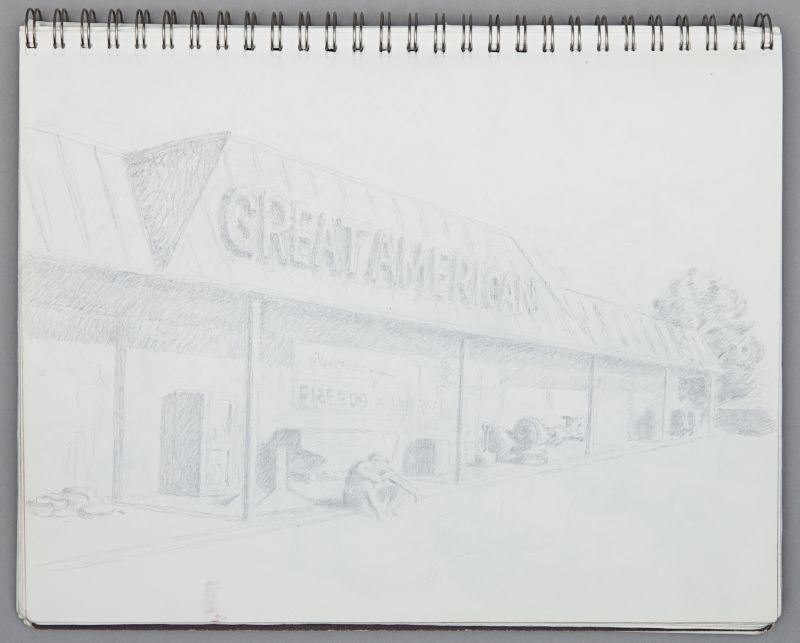
Among the most emblematic of these estranged spaces is Byrd’s drawing of Great American, a regional grocery chain rendered softly in graphite. The scene—a familiar slice of small-town life—should feel comfortingly familiar, mundane even, yet Byrd imbues it with an uncanny stillness. The storefront appears vacant and hushed, its quietude broken only by the presence of a lone figure slouched on the curb, body slack, face indistinct. Nearby, a kiddie ride sits motionless, unused. There's no interaction, no narrative action—only the stillness of waiting, or existing without clear purpose. The light is flat, the space oddly emptied of urgency. The result is a scene that feels suspended in a state of detachment; a grocery store transfigured into a liminal zone.
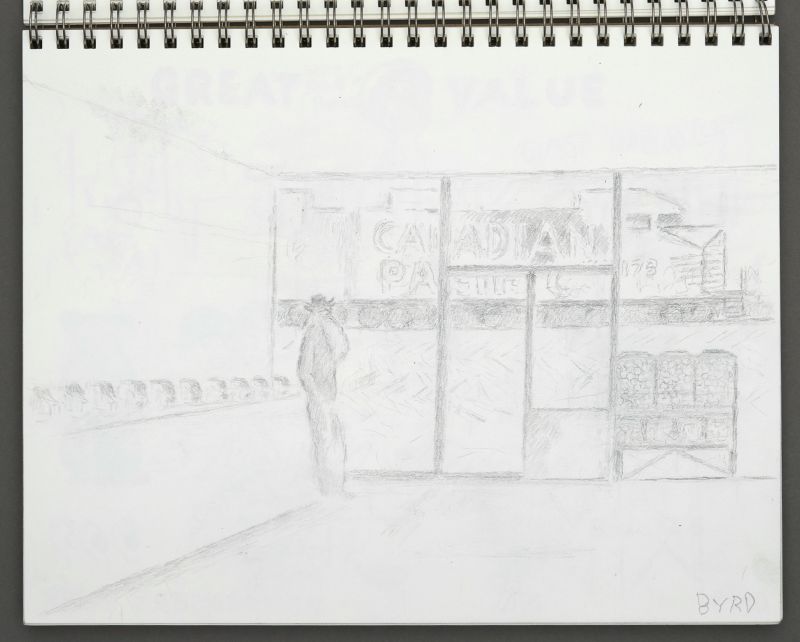
In Byrd’s hands, sites of everyday commerce and community rarely offer comfort; instead, they are rendered through the lens of distance; a kind of deliberate, observant solitude. If Great American suggests the vacancy of public exchange, Byrd’s drawings of laundromats take up its echo, pushing that sense of liminality even further. In one sketch, a man in a wide-brimmed hat leans against a row of faceless washing machines. His stillness contrasts with the presence of an eighteen-wheeler labeled
Canadian Pacific floating beyond the glass storefront window. Though the laundromat is a public space, implying movement, exchange, and activity, everything in Byrd’s rendering suggests otherwise. The man, central but solitary, is absorbed in contemplation. The trio of candy dispensers and row of coin collectors perched atop the machines are rendered with care but stripped of specificity; they simply exist, like artifacts in a dream.
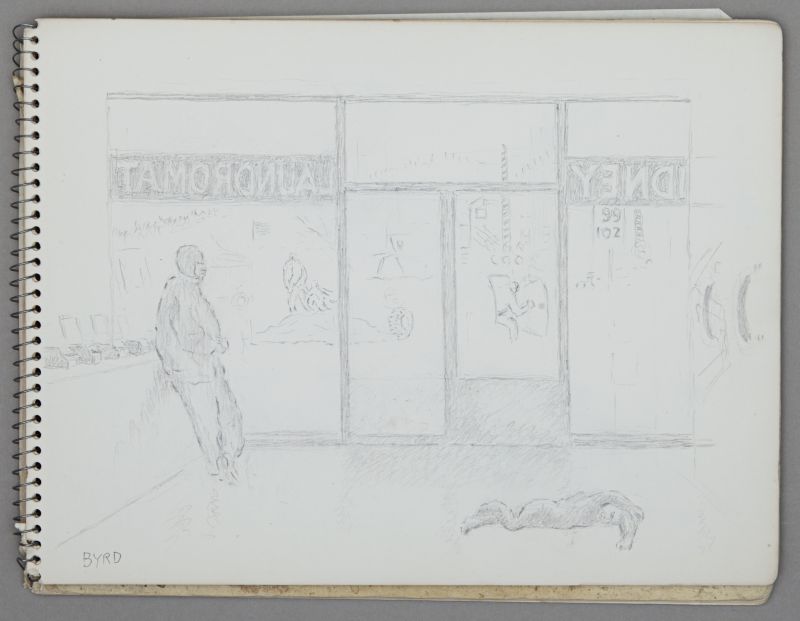
In a variation of this theme with a similar composition, Byrd introduces a figure in the foreground, lying with arms outstretched above his head, body contorted, as if seized by a fit or overcome by exhaustion. The leaning man remains indifferent, his gaze fixed beyond the window. Outside, loosely sketched vehicles and railroad crossings punctuate the space, but these signs of life offer no sense of forward momentum, instead reinforcing only a mood of paralysis. Time moves outside Byrd’s frame, but within it, all is suspended. In yet another version, the viewer’s vantage shifts outward, placing us outside looking into the Sidney Laundromat. Through its windows, shadowy forms bend to their tasks, caught mid-motion yet strangely still. A clock, above the doorway sits solemnly, its hands frozen, its promise of measured time rendered idle. The viewer stands apart, witnessing not activity but paused ritual: gestures repeated into abstraction. Each scene feels slightly out of step with time, as though filtered through memory or the detached lens of observation. They don’t evoke nostalgia or overt social critique—rather, they excavate the emotional architecture beneath the mundane, offering a vision of American life as something suspended, unmoored, and deeply introspective.
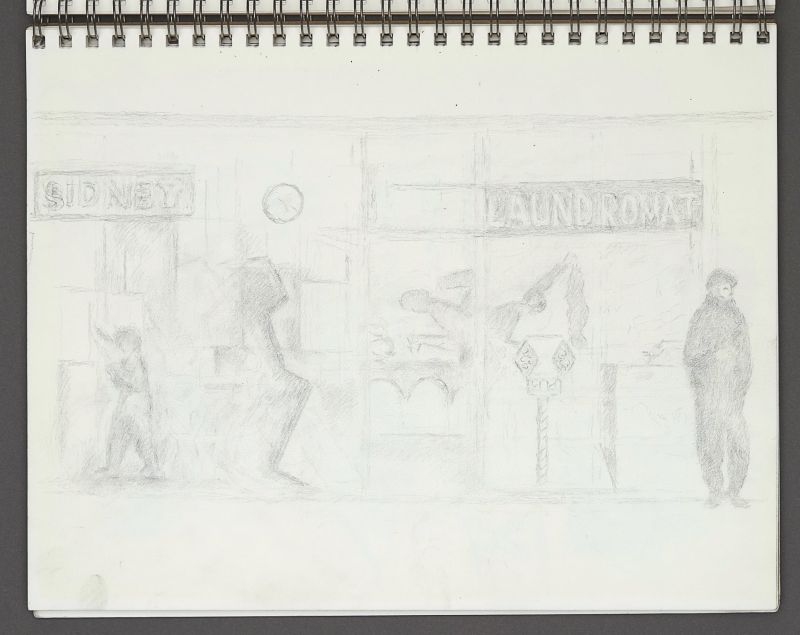
These are not postcard visions or drawings of a heroic Americana in the mode of Norman Rockwell, but rather meditations on distance—on the quiet, persistent gulf between the self and the world. Byrd’s America is not one of wistfulness or unity, but of watchful separation, where every encounter is filtered through the poetics of estrangement. This distance becomes a deliberate visual and conceptual tool—an approach that allows Byrd to see America slightly askew, as if through the veil of memories or dreams. What he renders, then, is not a portrait of America as it wishes to be seen, but as it is experienced in solitude: spectral, fragmented, and profoundly human.
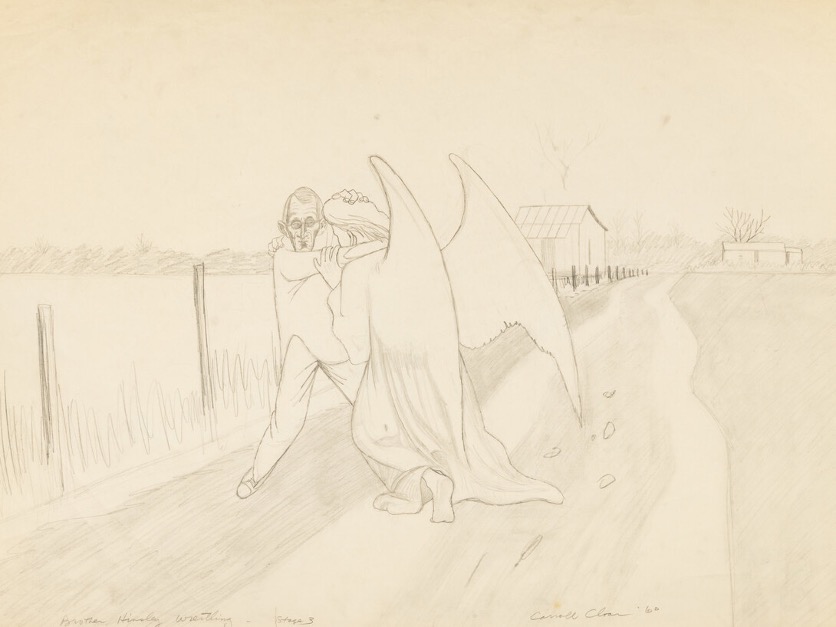
In this way, Byrd shares a deep affinity with other artists who explore similar themes of estrangement and psychological isolation, such as the Memphis-based artist Carroll Cloar (1913–1993). Cloar’s dreamlike renderings of the rural South operate in a similar liminal space, where the boundary between the real and the remembered blurs. Like Byrd, Cloar is not concerned with merely recording how a place looks, but instead how it feels in its psychological residue and how it lingers in our memories. Cloar’s Southern tableaux, with their flattened perspectives and eerie symmetry, evoke a world that is filtered through the haze of childhood recollection or ancestral lore. But where Cloar’s figures often seem trapped in a kind of timeless, folkloric suspension, Byrd’s images are more fragmented, unsettled—as though the very act of remembering has unraveled, leaving only glimpses or shadows of places and experiences. In this way, Byrd and Cloar both practice a form of rural Surrealism—not the high Surrealism of Dalí or Ernst, but a lived, awkward estrangement from one's environment that happens in plain daylight.
 |
|
Carroll Cloar, Brother Hinsley Wrestling with the Angel Stage 3 (Study), 1960
Graphite on paper, photo courtesy of Andrew Edlin Gallery |
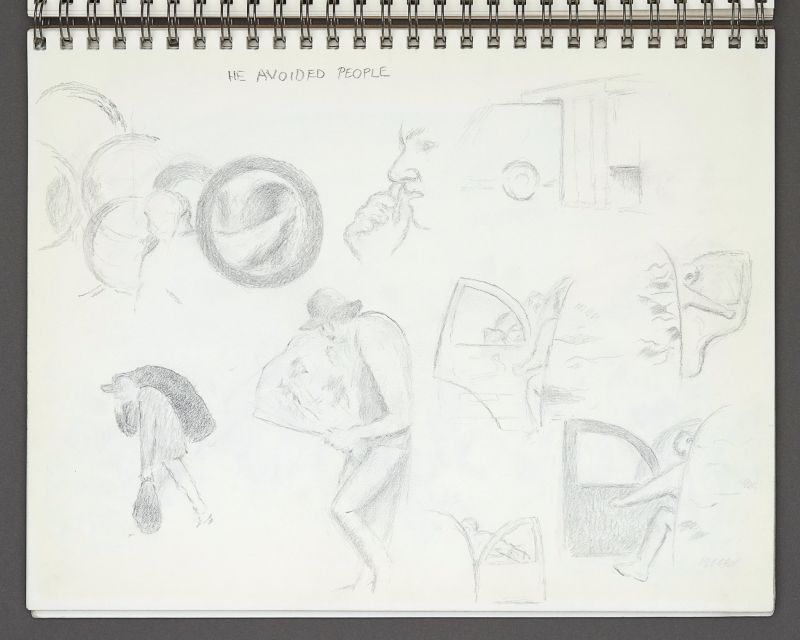
This sense of estrangement from one's own surroundings is perhaps most vividly conveyed in Byrd’s drawing He Avoided People—a collection of fragmented vignettes that capture figures in states of solitary action: one bends under the weight of a large bundle, another exits or enters a car. Though these figures occupy the same space, they remain unconnected. Each is isolated in their movements, unengaged with those around them. Byrd’s choice to depict gestures so commonplace, reading a newspaper, scratching a nose, swapping laundry—elevates them beyond the realm of the ordinary. The familiarity of these gestures should make them almost invisible, yet in Byrd’s hands, even commonplace gestures take on a feeling of strangeness. One of the things Byrd does best is allow his drawings to dwell in the spaces between things; the intervals of waiting, of watching, of quiet persistence, where the texture of lived experience is felt most. Central to this effect is his masterful use of negative space, where absence becomes as meaningful as presence. In these spaces, the boundaries between “inside” and “outside” often dissolve, collapsing distinctions between private and public, personal and collective, commercial and recreational. Byrd shows that alienation isn’t just something you find in hospital wards or trauma centers; it is a pervasive aspect of daily life.
Take, for example, Ghosts, Family Life, a drawing in which the distinctions between interior and exterior space dissolve almost entirely. Byrd’s soft, delicate pencilwork gives the scene a spectral feeling, as if the figures are emerging from memory or consciousness itself—fading in and out of existence. The composition resists cohesion; each figure is sequestered in his or her own emotional or spatial zone, largely unaware of the others. Their faces are indistinct, their identities only partially realized, heightening the sense of emotional fragmentation. At the center, a stout woman clutches an Illinois State Journal sack, her posture stiff and despondent. She seems burdened by her own thoughts, carrying an emotional weight made tangible by both her monumentality and the physical heft of the sack. To her right, a distant pair of figures embrace—a motif Byrd recycles occasionally in interior scenes—while a woman pushes a pram nearby. Anchoring the foreground is a framed photograph of a sailor, possibly a Merchant Marine, perhaps an allusion to Byrd’s own service during WWII. On the right, a cluster of figures engages in more leisurely activities: a man playing the trombone, another holding a paintbrush and pail, a little girl at play with a cat. Yet the most arresting element is the receding figure in the background, seen only from behind as she disappears into a dark, shadowed tunnel—evoking the long corridors Byrd often sketched of the psychiatric ward of the VA hospital. This subtle, receding presence evokes the lingering presence of past institutions: the “ghosts” of regimented, clinical spaces that shaped Byrd’s own past, and which continue to cast their shadow over domestic life, intruding into the private and everyday. With no clear boundaries between inside and outside, the space feels unanchored, almost dreamlike. Byrd seems to be saying that the emotional lives of the American family cannot be neatly contained within the walls of the home, nor can those walls fully shield them from the pressures of the outside world—social, historical, or institutional—that seep in and shape their private lives.
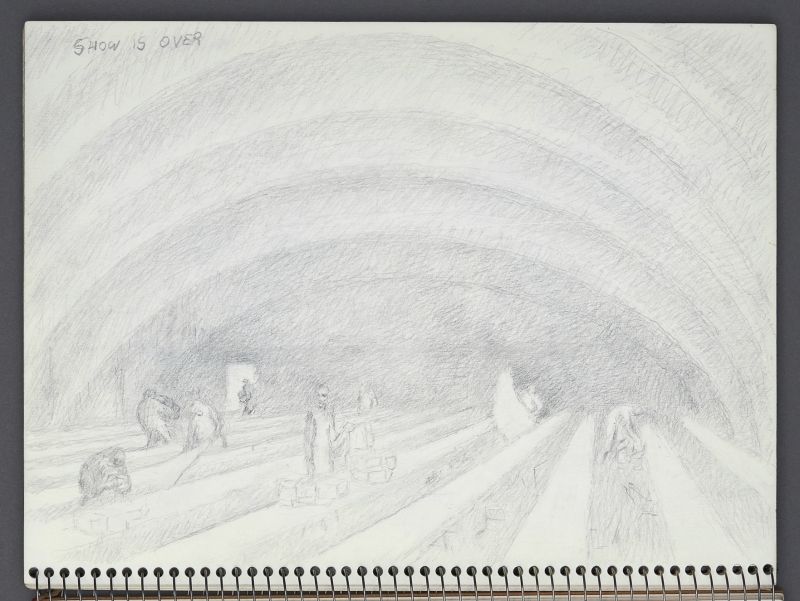
To study Byrd’s drawings closely is to enter his interior world—to share in the same quiet intensity that gives rise to his drawings’ uncanny stillness, their sense of being suspended outside of time: familiar yet estranged. The power of his work does not lie in explicit narrative or illustrative detail, but in the cumulative effect of countless small, deliberate marks, each drawn with a near-hallucinatory concentration. It is in this patient accrual of line and texture that his interior landscapes take shape, as, for instance, in his drawing Show is Over. Within its softly arched interior—part tunnel, part amphitheater—figures bend, kneel, and shuffle amid long receding rows, their gestures hermetic and indeterminate, dissolving into an ombré graphite haze. Depicted reality dissolves. A faint inscription at the top, “SHOW IS OVER,” reads less as a declaration than as an echo, a remnant of language drifting through the aftermath of some unspoken event. Prolonged attention brings awareness of the artist’s hand—the careful web of cross-hatched marks, the subtle gradations of graphite, and, above all, the discipline and concentration that produced them. Byrd’s drawing rewards reciprocal patience: the longer one looks, the more the image seems to slow perception itself. Looked at literally, Show is Over could be read as a landscape—a cavernous hall, perhaps a grocery store, or a factory—but Byrd transforms such spaces into psychological meditations. Like many of his compositions, this one resists closure; perspective flattens, light is diffused, and the scene seems perpetually on the verge of fading. The title itself guides our interpretation, inviting viewers to consider what has come before and what remains. And what remains is the act of drawing itself—a sustained gesture of attention that becomes its own subject.
Byrd’s prolonged, almost obsessive scrutiny of private and communal spaces feels not only like an aesthetic strategy but also a way of negotiating his own experiences of estrangement, first as an adolescent navigating the foster care system, and later as an adult confronting the lingering aftermath and psychic toll of war. Through the patient, exacting act of rendering the world in minute detail, Byrd invites us to see as he sees, and perhaps, in that process, to come closer to embracing his contemplative and reflexive sensibilities. His images speak quietly but insistently to fundamental human desires: to connect, to see, and to understand. Each drawing becomes, in a sense, a self-portrait—a mirror reflecting Byrd’s interior world. To truly look at Byrd’s drawings is, perhaps, to recognize something of Byrd. Because they demand that we quiet ourselves to apprehend them, his drawings enable us to consider thoughts about reality that we might otherwise be unable to formulate. They are meditations on themes of authenticity and imagination, canny and uncanny, but most of all, they are ludic invitations to look closely and study carefully.
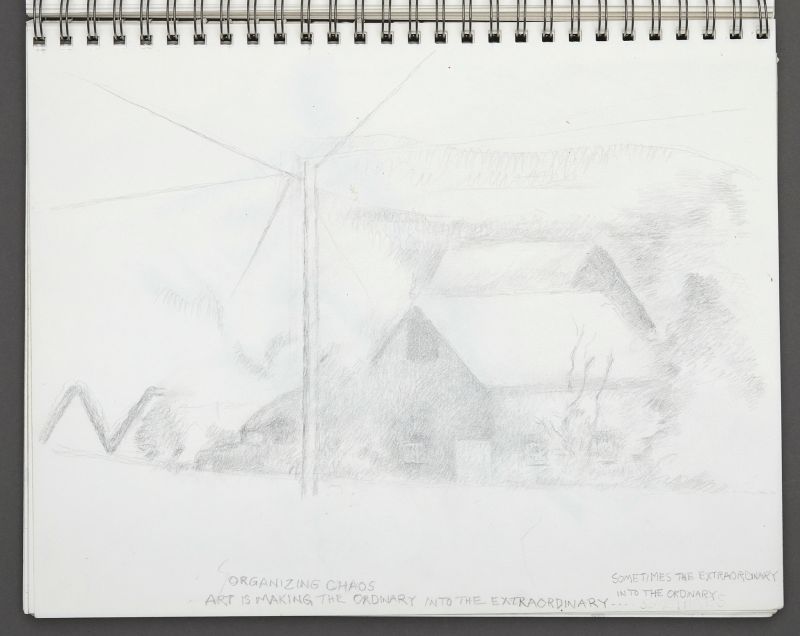
If Show is Over captures Byrd’s withdrawal from spectacle, then Organizing Chaos offers its quiet resolution. The scene is outwardly unremarkable: a house, a telephone pole, a few slanted rooftops dissolving into tonal mist. Yet the title itself functions as both declaration and self-portrait. Byrd’s entire drawing practice could be understood as an effort to organize chaos—to impose fragile order on the perceptual flux of daily life through the slow discipline of graphite. Beneath the image, his handwritten inscription extends this thought: Art is making the ordinary into the extraordinary...sometimes the extraordinary into the ordinary. The phrase distills the oscillation at the heart of Byrd’s drawing practice—drawing as a form of both release and restraint, a negotiation between revelation and routine.
In this drawing, the familiar rural motif—the pitched barn roof, the power line bisecting the paper, mountains swelling in the distance—is rendered with the same hushed care that animates Byrd’s depictions of storefronts and laundromats. Light and shadow blur into one another, forms emerge and dissolve, and what might otherwise appear banal becomes charged with introspection. Byrd’s America is one seen through the fog of recollection, where every object fades out of focus under the pressure of memory. Byrd’s marks never assert themselves; they recede, refusing to dazzle or proclaim. His surfaces are muted, even self-effacing, yet within their restraint lies a profound attentiveness. In Organizing Chaos, drawing becomes a mode of thinking—an attempt to stabilize experience while recording it. The soft tonal gradations and the tentative edges of the barn and foliage all seem to hover between appearance and disappearance. Byrd renders familiar places alien not through distortion but through affect, deliberateness and distance. Seen in the context of his oeuvre, Organizing Chaos feels almost like a statement of purpose. It acknowledges the artist’s position between observation and withdrawal, between participation and detachment. Byrd’s America is not the bustling, mythic landscape of mid-century optimism, but a world filtered through introspection—a place where the extraordinary reveals itself in the most unassuming corners.
To end with this drawing is to return to the essence of Byrd’s drawing practice: the transformation of attention into form. Byrd’s drawings teach us how to look again—how to find the extraordinary within the ordinary, structure within chaos, and communion within solitude. In the faint graphite haze of Organizing Chaos, the artist’s philosophy crystallizes: that to draw is not simply to represent the world, but to reorder it—to make sense of its mundane absurdities, one pencil mark at a time. In the end, Byrd’s drawings exist within that delicate space between looking and retreating, between the world as it is and the world as it feels. Show is Over and Organizing Chaos together trace the movement of an artist inward: from the dissolution of spectacle to the measured reconstruction of the everyday. What remains is not absence, but attunement; a vision of America rendered askew, seen through the filter of solitude and memory. In Byrd’s hands, graphite becomes an instrument of contemplation, transforming the ordinary into a quiet metaphysics of seeing. His drawings do not depict withdrawal; they practice it, offering stillness as a way of knowing.
Rebecca DiGiovanna is a Memphis-born, New York–based curator and an Assistant Curator at The Drawing Center, where she has worked since January 2019. Her recent and forthcoming projects include “Joan Jonas: Animal, Vegetable, Mineral” (2024), “In the Medium of Life: The Drawings of Beauford Delaney” (2025) and “I’m a Drawing: Works on Paper by Pope.L” (2026). She holds an MA from Hunter College, where her research examined politics and gender in seventeenth-century women artists’ allegorical self-presentations of melancholia. Before joining The Drawing Center, she curated the traveling exhibition “Blurring Boundaries: The Women of American Abstract Artists, 1936–Present” (2018–2023). She lives in Brooklyn
- David Byrd Estate Website: About [ https://www.davidbyrdestate.com/about ]
- Ibid.