
Meeting David Byrd
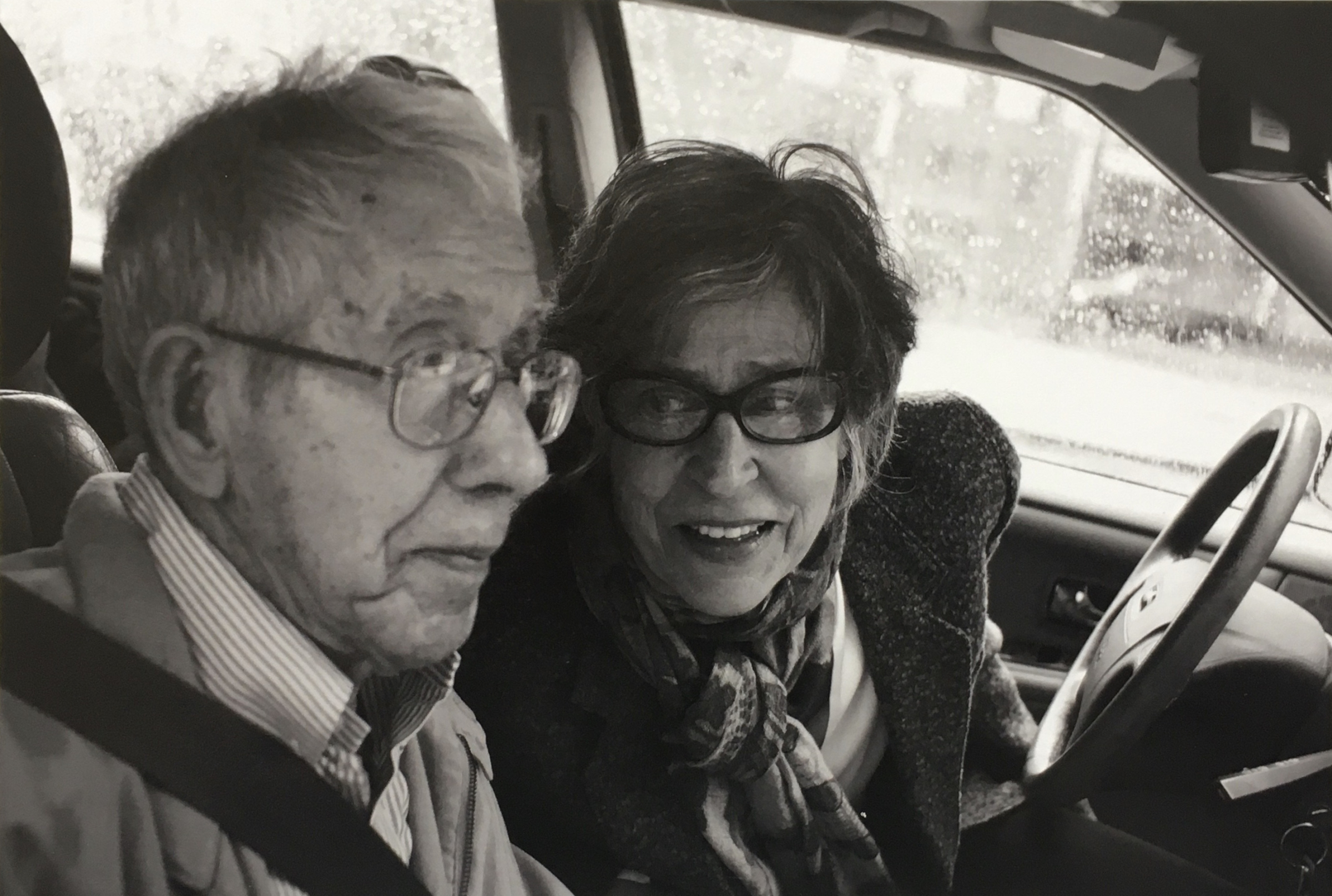 |
| David Byrd and Jody Isaacson in Seattle, WA, during the Greg Kucera Gallery exhibition, 2013. |
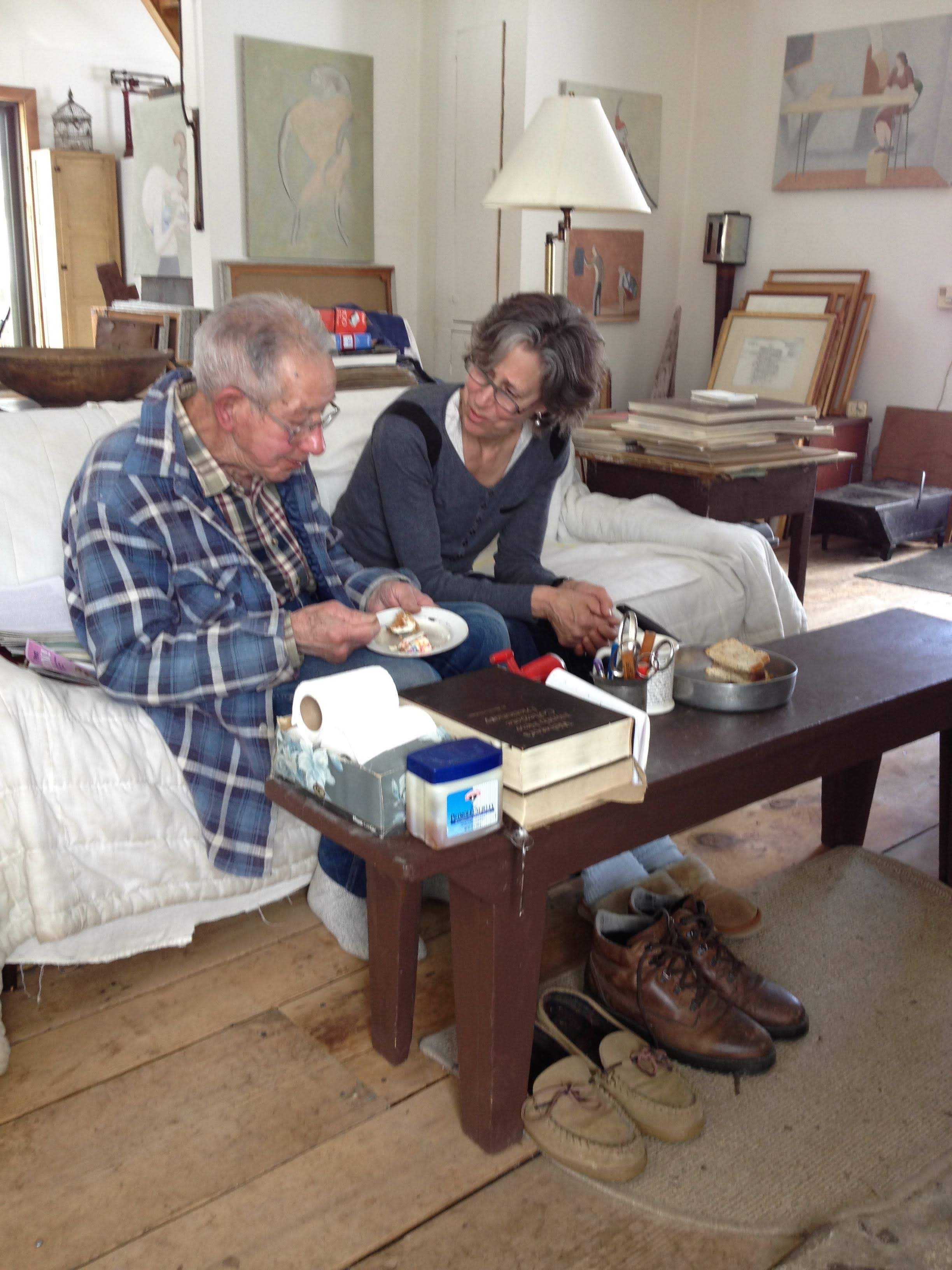 |
| Jody and David at Byrd's home, Sidney Center, NY, 2013 |
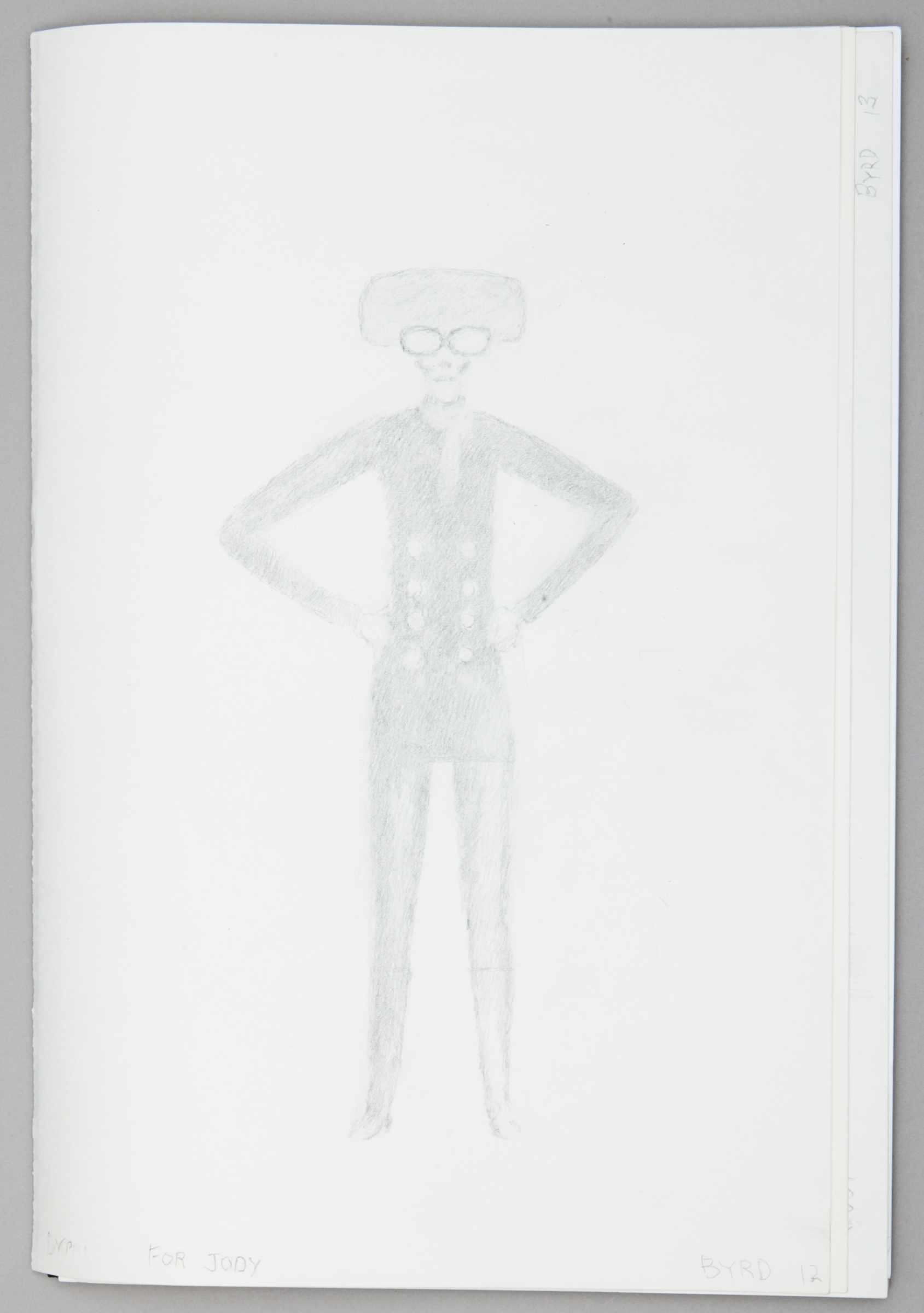 |
|
David Byrd's sketch of Jody. Sketchbook 18, p.13, 2013 |
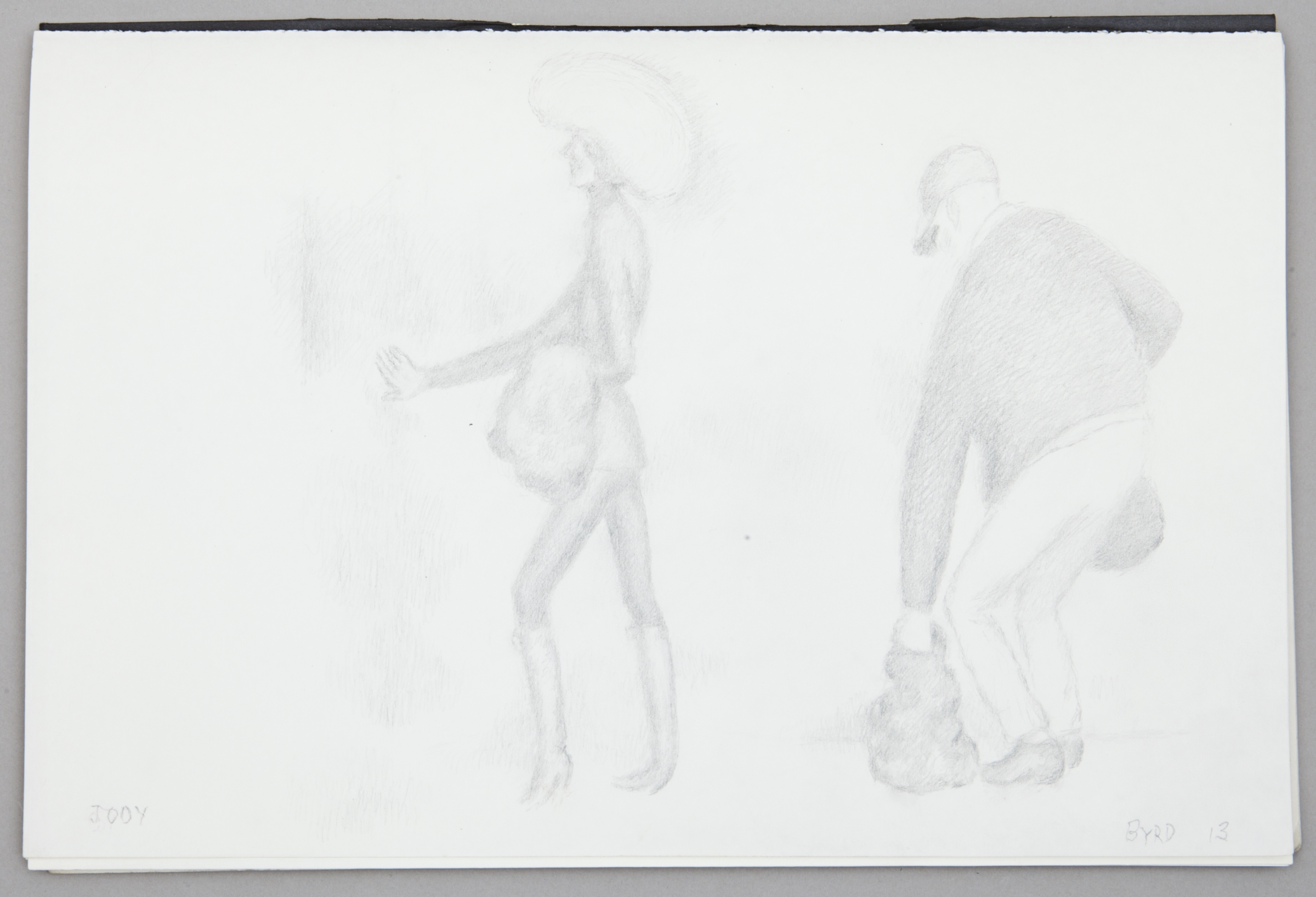 |
| David Byrd's sketch of Jody and her partner, Steve Hay. Sketchbook 18, p.14, 2013 |
I met David Byrd on September 10th, 2012, and my relationship with him has been one of the most gratifying experiences in my life. He immediately reminded me of my grandfather, whom I loved. Whenever I had passed David’s house, the oddly arranged objects in the field in front of it intrigued me: a rusted steel cube, concrete debris, auto parts, wood scraps. Each time I passed I looked for signs of life, but never saw anyone. On this particular day, as I drove by, I saw a slight, stooped man walking toward the house. I circled back and asked him if an artist lived here. He replied, “Well, I’m not sure about that but you’re welcome to come in and tell me.”
David had arranged his living space not as a home but as a studio and gallery in which every object was carefully placed. A dark stained pitcher sat on a high blue stool, in back of which stood an old paintpeeled door; a variety of glass and ceramic bottles were positioned thoughtfully on shelves, in window ledges, on tables, as if in a display; large, gesturing, crudely carved wooden figures contrasted with the sticks purposely placed in paper bags outside the front door. And the paintings! Everywhere. On every wall, stacked against every wall were the paintings.
In 26 years of living alone, he had had little to do with people. He built his house by himself. He had never exhibited or sold any paintings. Every work of art he had ever made was inside the house. Before I left, he insisted I see his book. The book is David’s magnum opus. Handmade, it is 180 pages, done in graphite and colored pencil, illustrating many of the major themes of his paintings. The drawings were not studies for his oil paintings; they were sketched from the paintings. The book is also filled with an amazing amount of text describing the challenges and rewards of dealing with the patients at the Montrose, New York, V.A. hospital, where he worked for many years as an orderly. More than anything, David wanted this book published.
I wanted to help. My colleague Jessica Farrell and I were curating a small exhibition at a local community center. David allowed us to include 43 of his paintings and three large sculptures. The show was a success and David was ecstatic from the experience.
So happy, in fact, he wanted something more, something that had eluded him his entire life. David was seeking the validation that he was an artist, that he had a voice, and that the pictures he had made contributed to the American art canon of the 20th century.
I brought David’s work to the attention of Greg Kucera, a gallery dealer in Seattle who, recognizing the quality of David’s work, immediately arranged for an April exhibition. Five days before David and I were to leave New York for the show, he was diagnosed with terminal lung cancer. Miraculously we made it to the opening. Every detail, from getting David to Seattle, through the show, and back to the V.A. hospital in Albany, was a monumental challenge. Even so, David thought—and surely the people who met him thought—it was worth every effort.
Suddenly I found myself not only advocating for David’s work but also managing his care and dying. His illness progressed rapidly. He underwent radiation treatment at the V.A. hospital in Albany. Ten days later, I moved David to an assisted living facility in Oneonta. He wanted to finish a few paintings, so I moved his painting materials to his apartment. He was unable to take care of himself, though, and, within days, unable to walk. I moved him to the V.A. hospital in Oxford. I hung his paintings in his room. The staff loved his work, and many had taken the time to go to Greg Kucera’s website and look at more paintings. It was the man himself who made them so curious about the work: his tone of voice, the soft graciousness of his cadence and his gratitude for everything they were doing to make him comfortable.
I brought David home on two occasions in the spring, his favorite time of year. He wanted to finish signing paintings and say goodbye to his house. During the last three weeks of his life, close, albeit recently found, friends surrounded him. On May 30th, 2013, David died peacefully in his sleep at age 87.
My time with David, however brief, changed my life. He reaffirmed for me that art is my life. My most meaningful memories of our time together are of reading his book out loud, with him sitting next to me; looking over his ten sketchbooks; and listening to him talk about his paintings and the act of painting. He also talked about opera, movies, his family, his career as a bottle collector, his experience building his house, frugality, how to build a good fire, cooking and eating. My grandfather Gib Turner and David were both very much alive during their lives, alive in their art and in their capacity to feel and share their thoughts. Their lives were works of art.
For me painting is a matter of religion; to keep on painting is the main thing.
—David Byrd