
I prefer this to be in a museum…
A chance to be something1
The French painter and theoretician Amédée Ozenfant (1886-1966) had more than a thousand pupils in the various schools he founded in Paris, London and New York. In his Mémoires, he is careful to mention a few of them, including David Byrd, favoring him with flattering appreciation: “What has become of you, David Bird2 [sic], an admirable draftsman who had to leave school to earn a living as a salesman in a wine merchant’s store?”3
|
|
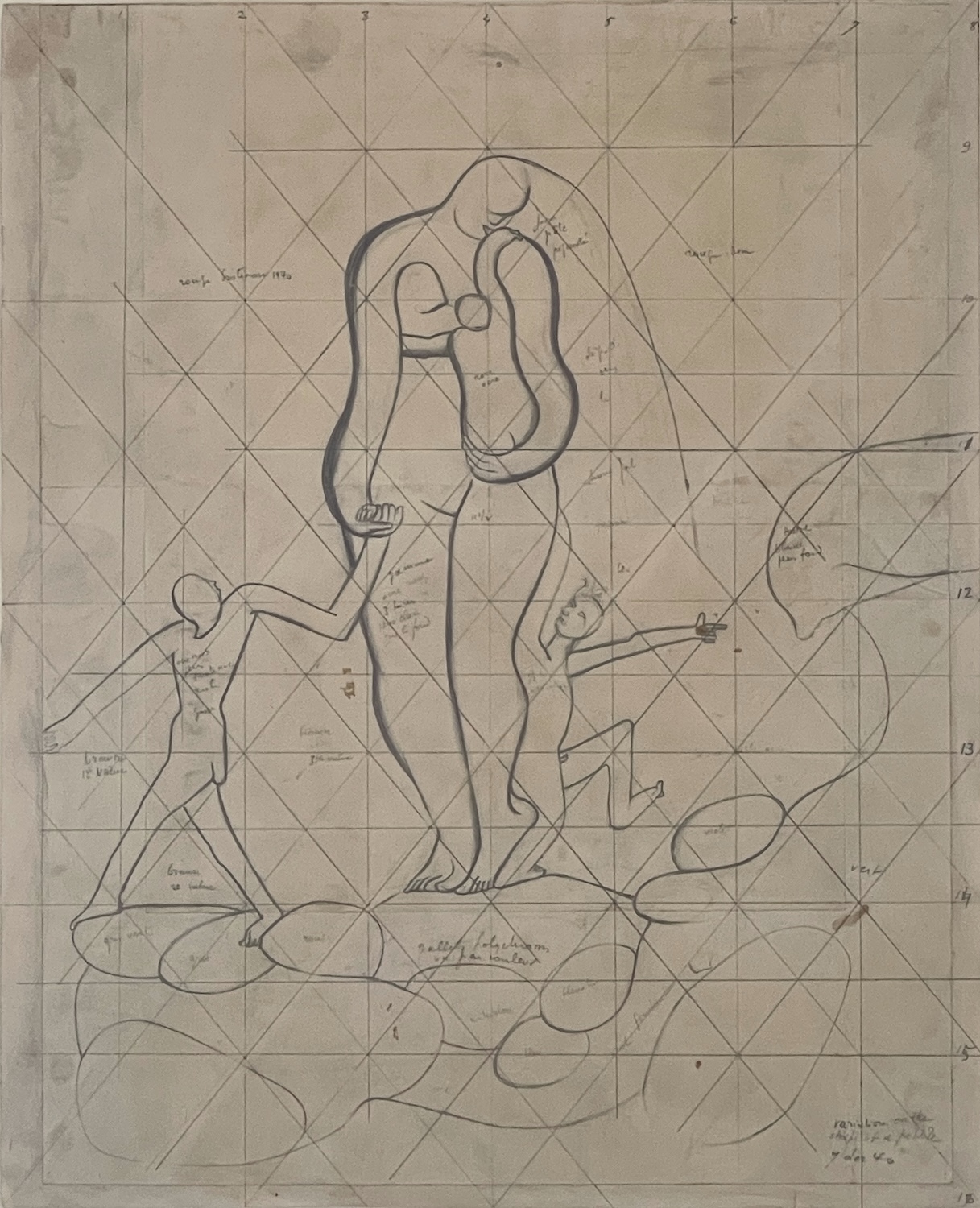
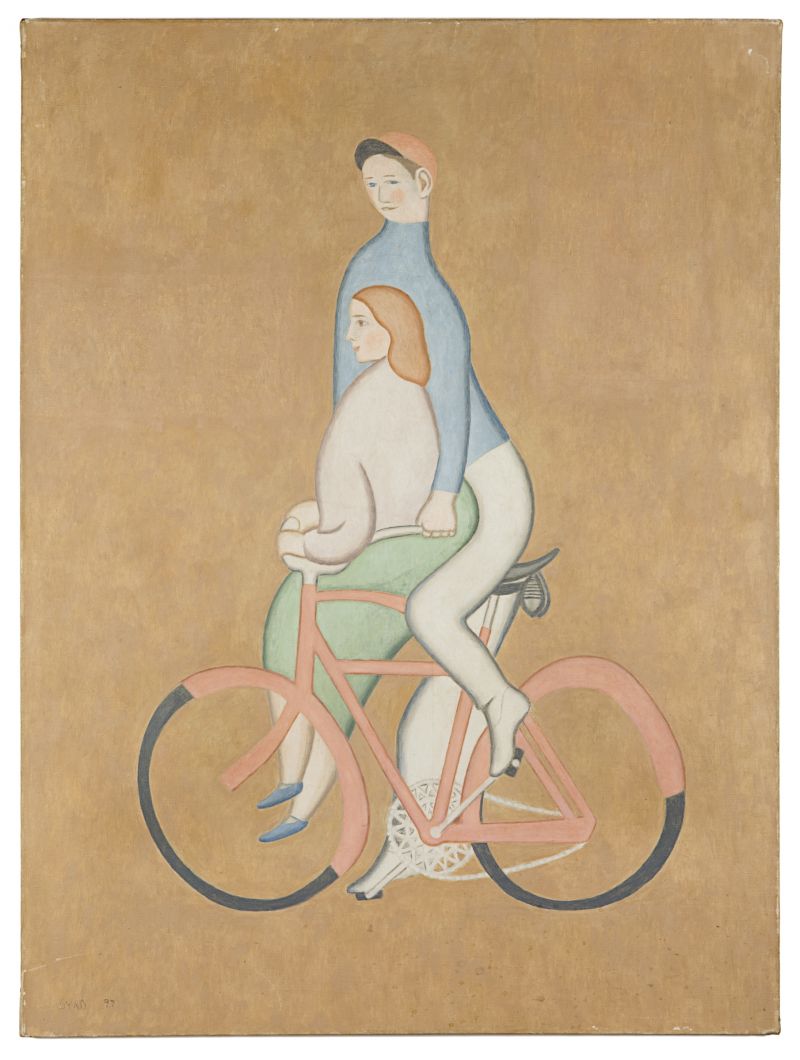
A companion of Byrd’s in the same class, 1949-51, and three years his senior, was Richard Artschwager,4 whom Ozenfant omitted to mention. Not notably precocious, it’s true, Artschwager had his first solo exhibition only in 1965,5 at the age of 42. As for Byrd, he never expected to have one. He was 86 when he exhibited for the first time, thanks to Jody Isaacson, his neighbor, who had just discovered his work, and Jessica Farrell, both artists. The event was held in 2012 in the former public school6 of a Catskills village, Sidney Center, in upstate New York, where he lived. And the consecration was granted him six months later by the Greg Kucera Gallery,7 which represented Isaacson, in Seattle, with an exhibition that brought together 105 paintings, and just happened to become an unexpected media and commercial success. The artist, however, hardly had time to enjoy it, since he died on May 30, 2013, of a late-diagnosed cancer, less than two weeks after the exhibition closed.
* * *
The book of a life
Lacking exhibitions of his art, Byrd never showed it to anyone for many years, while still working assiduously at it. But from 2002 until his death, he cherished the plan of publishing a book of the impressions he recorded in drawing and some observations taken in the Veterans Administration Medical Hospital in Montrose, New York, where he was an orderly from 1958 to 1988. The maquette that he devised very precisely was issued in a posthumous facsimile edition in 2020 on the initiative of his estate and the Anton Kern Gallery,8 which has represented the artist since his first New York solo exhibition in 2019.9 The medium-sized sketchbook that serves as a support for the original contains 169 drawings made feverishly on scraps of paper sometimes measuring no more than 3 × 5 inches, each protected by a plastic sheet cut out to measure, unlike the texts, which are taped in without particular care.
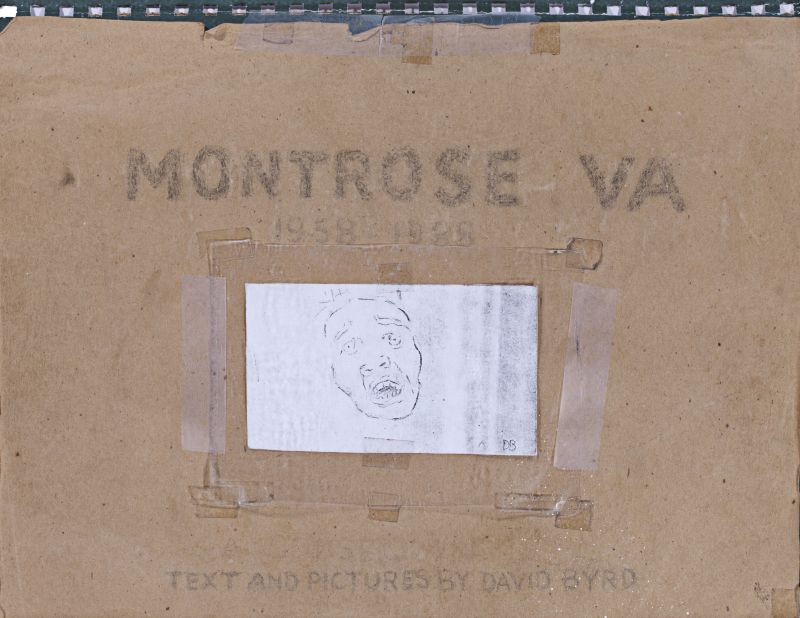
Still without sketches in it, a sketchbook is a collection of blank pages when it just comes from the store. (“Left blank for your brilliance” is the encouraging slogan chanted on every page of the notepad I found in my hotel room!) The artist merely had to fill this white paper with the chosen material he already had, or to enrich it as he went along by slipping in new drawings in the same format, on kraft paper or black paper, and sometimes combining the two. Into this collection he inserted fifty-eight additional drawings very meticulously made in colored pencil of his existing paintings (a very skillful technical decision to approximate the color tones of the pigment), proof that in this project the artist did not abandon his principal vocation for that of a reporter.
Byrd submitted a painting to a curator at the MoMA in 1950. The rebuff he received was such that he never approached anyone for nearly 40 years. Then he eventually wrote twice to the Whitney Museum. The first time, in 1987, to present his artist portfolio: “I would appreciate anything you can say about the slides.”10 The second time, in 2004, about this book project: “I realize I am imposing and taking your time…”11 There was no response in 1987. The answer to his second attempt was not long coming. It was negative, impersonal and doubly frustrating: “The Whitney Museum does not have programs for publication outside exhibition-related projects.”12 For his book, the artist also approached Cornell University Press, The New Yorker, and he sought the advice of the legal services of the veterans’ hospital as he wanted to safeguard himself against any possible recourse by patients or their families, in case they recognized themselves in his drawings, many of them made long after he had left the hospital.
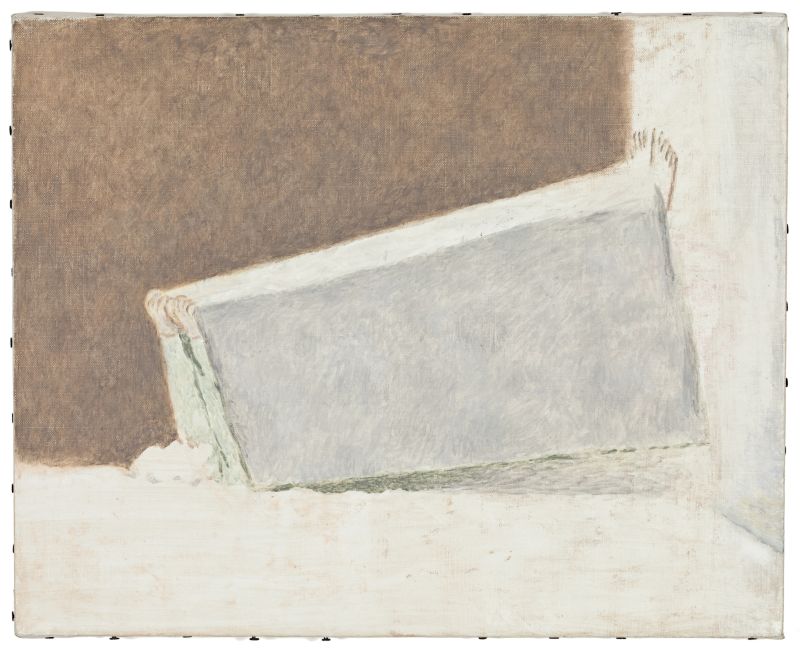
To devote himself better to his art, Byrd always accepted menial jobs. “I have found that bad jobs can produce very good pictures. Don’t know what good jobs produce.”13 So ends his artist statement testament written in October 2012, before the end of the schoolhouse show. Hired for night duty at Montrose, Byrd drew by night and painted at home by day. At night, his rounds took him to the refectory, the dormitories, the showers, wherever his duties as night orderly called him. And the insomniac actors of his shadow theater wander through the corridors by day and by night,14 rarely noticing the presence of the orderly when he was drawing them, and who kept on drawing even when no one appeared before him. The sleeping patients obviously kept their poses perfectly.
* * *
Dams and forking ways
The admirable work done by Farrell and Isaacson on behalf of the David Byrd Estate has brought to light and listed more than 3000 drawings on plain paper and nearly 900 others (sometimes double-sided) found in nineteen sketchbooks. Though they are undated, the latter make it possible to follow, in the sequence of the contents of each, the artist’s concerns and the routine of his very modest existence. Not all of them are connected to his experiences at Montrose, and it is difficult to determine the order in which he made them. The catalogue raisonné filters the drawings and the paintings by ten themes.
Whether they were inspired by the immediate surroundings of the artist’s successive homes, by travel between them and his workplace, or by the grounds of the Montrose hospital, his most striking landscapes are urban or semi-urban, and those where roads, bridges, tunnels or dams are massively superimposed on some natural setting (SK1-4R, SK2-53LR). These huge infrastructures are charged with psychological overtones. They emphasize an exclusive alternative between entry or exit,15 between two possible directions — the painting entitled A Road Going Two Ways (P77) dates from 1988, about the time when Byrd retired and was able to use his time as he wished. Or they point to a dead end and the confinement suggested by a dam looming up in the midst of a previously open space.
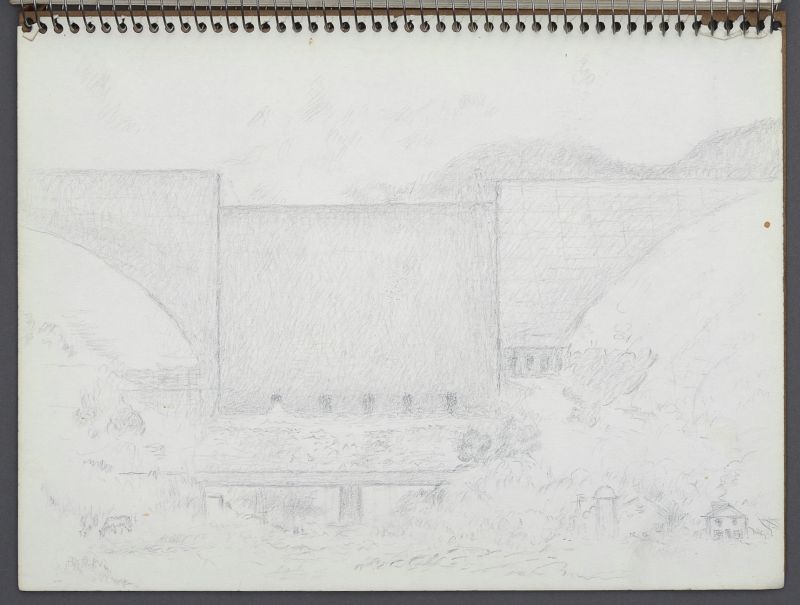
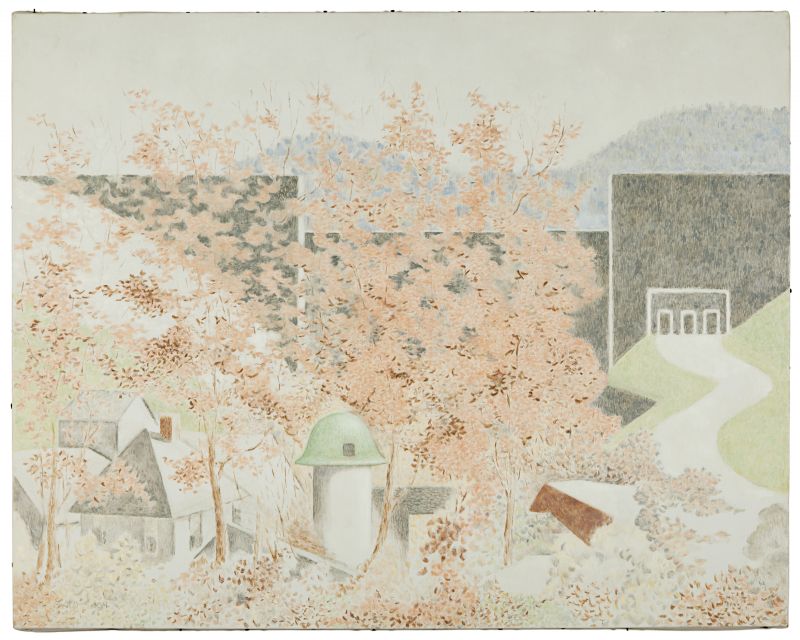
But do the landscapes have to bear a human imprint to be as important to our eyes in the artist’s oeuvre as his other works explicitly linked to human torment? And are they consequently insignificant when depicted from a dominant viewpoint in the Catskill Mountains (P318, SD-1127, SK4-38R), which seem untouched?
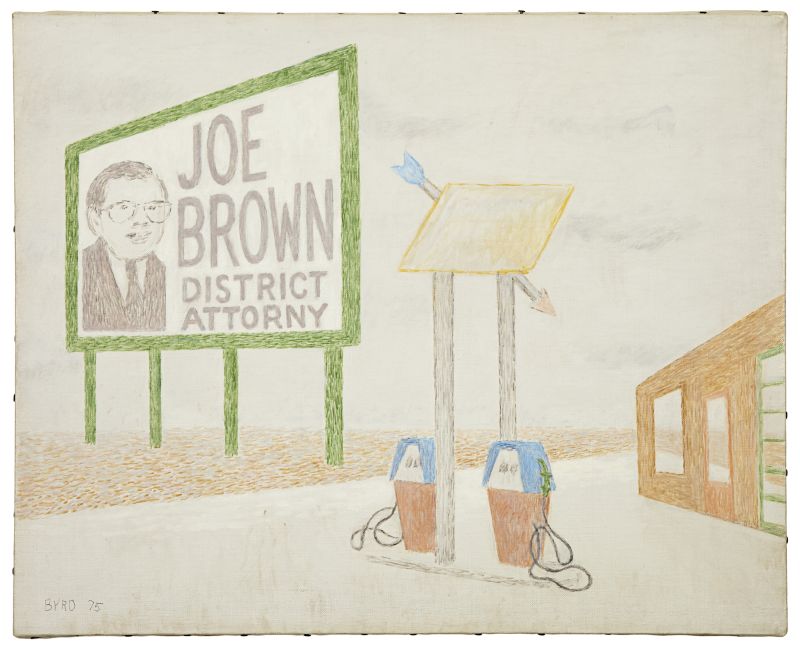
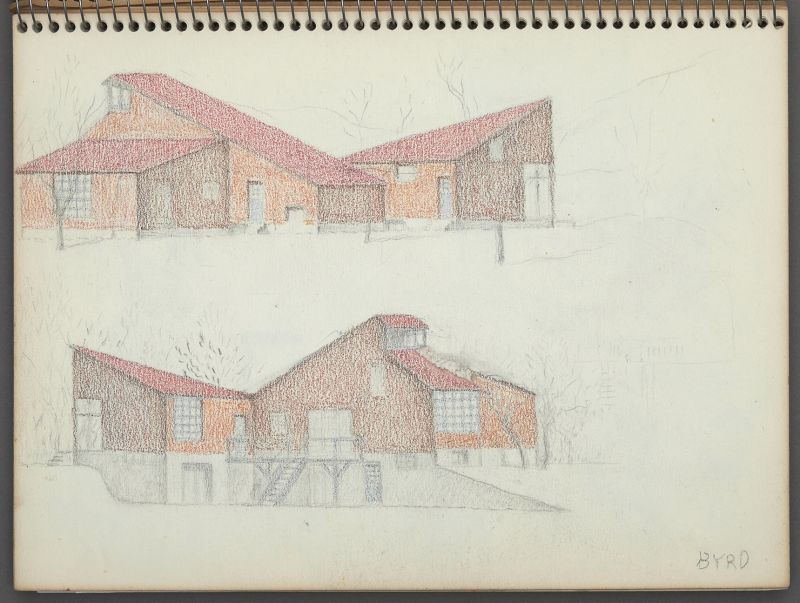
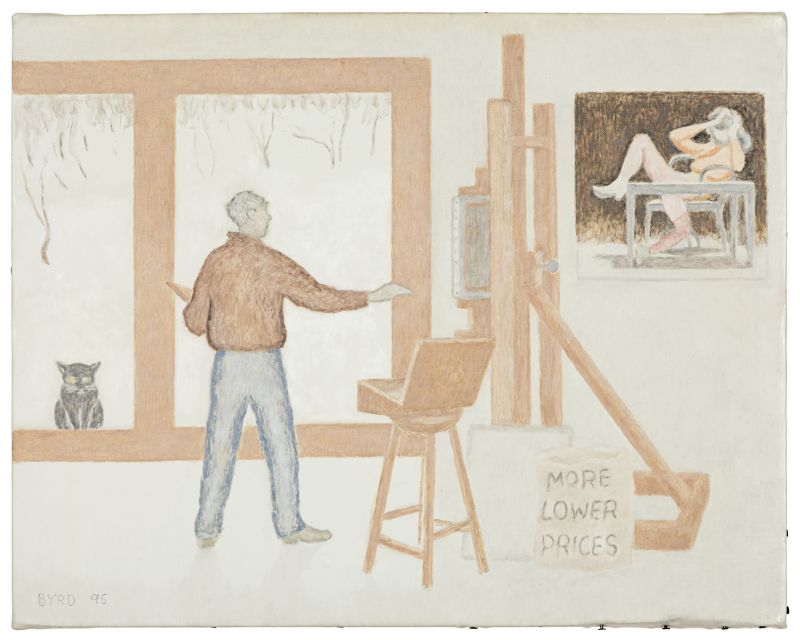
The Purist movement was co-founded by Ozenfant and Le Corbusier, who met at the home of the architect Auguste Perret, a pioneer of reinforced concrete. Architecture, both interior and exterior, plays an important role in all of Byrd’s work. It also prosaically introduces technical problems of perspective and geometry that the artist, himself the architect-builder of his own house, posed and solved in a diagrammatic way, either by exaggerating the vanishing lines — District Attorney, 1975 (P100) — or by eliminating them in favor of axonometric perspectives, artificially correcting the interpretive aberrations of natural vision. In this way, Byrd laid out his buildings with a ruler in all his paintings, as well as in the numerous sketches for the construction of his house, his last one, which took him five years to complete. In this time, he lived on the lot in a very basic hunter’s shack.
* * *
A promising future
The contrast is nevertheless striking between this applied geometry and the tortured, frozen or dancing silhouettes of the patients of the Montrose hospital. And it is even greater when these figures are placed in a symbolic architecture reduced to the type of the shoebox, where the alienated body has to contort itself in the space assigned for its safety and… the safety of the people living outside in freedom.
It was no accident that Byrd repeatedly depicted individuals entering or exiting from automobiles, or others seemingly shoehorned into these sorts of rolling aquariums. In French, the rather rare word désincarcération is used to describe the delicate operation of extricating a conscious or unconscious driver trapped in a crashed vehicle. Inside, outside: in the painting entitled Man Waving, 1997 (P71), a man sticks his arm out of his car window to wave to an acquaintance outside our view. He is setting off, and his gesture is addressed to those left behind. Inside, outside. The painting and preparatory drawing are annotated: “My brother, Carlyle, leaving for work.” A taxi driver, Carlyle, David’s elder brother, predicts a bright future for David in a letter to their mother: “He is the one who is going to take the cake in this family.”16
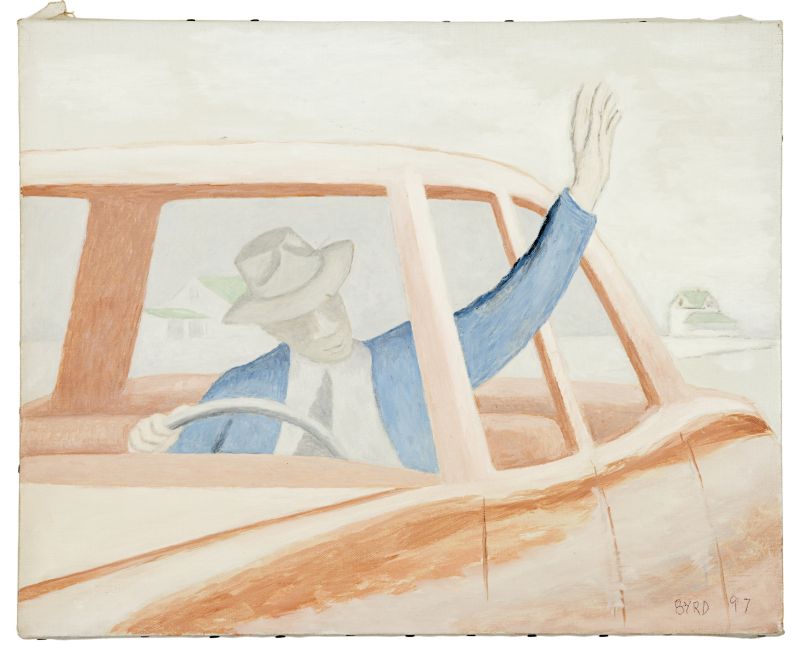
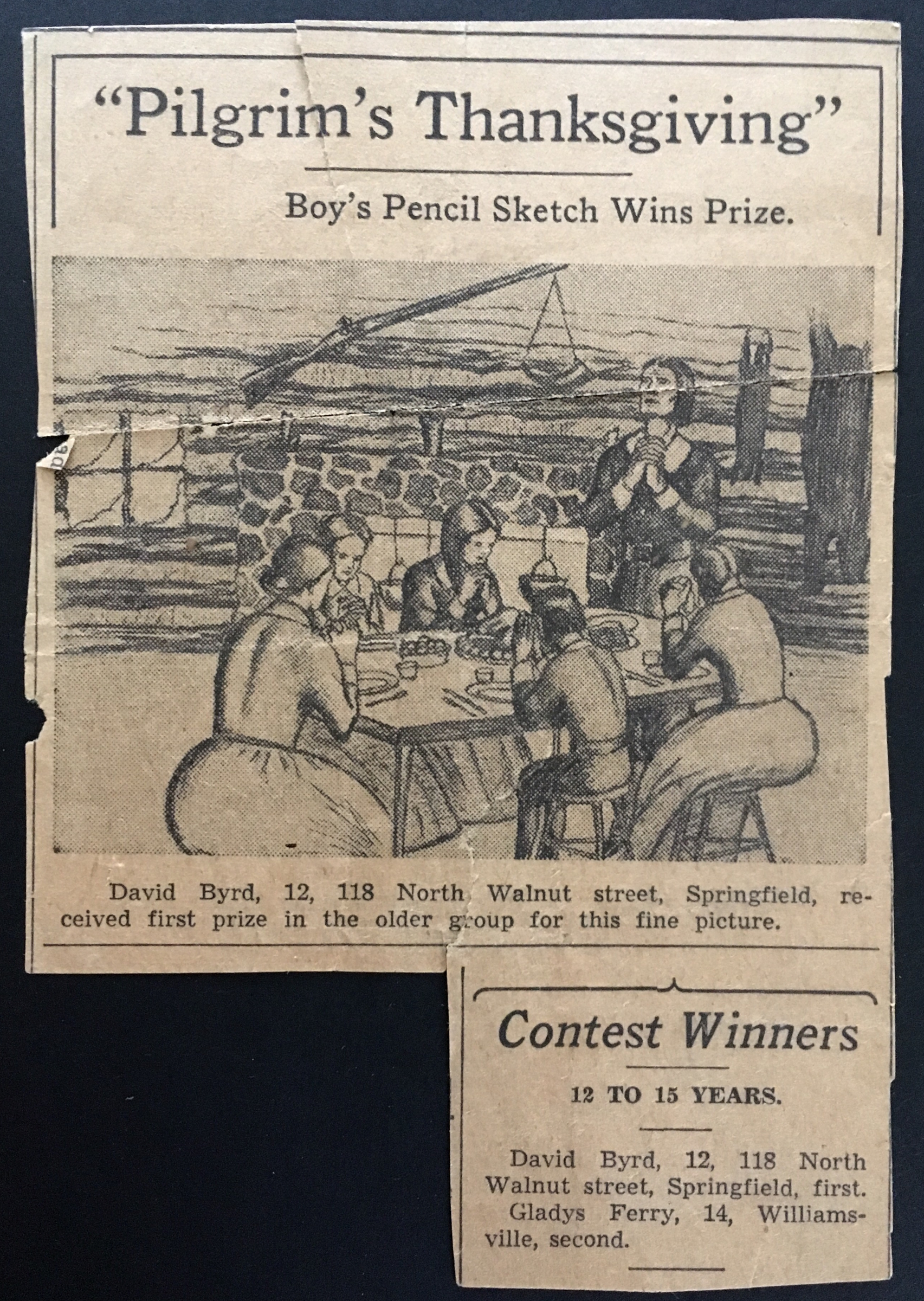
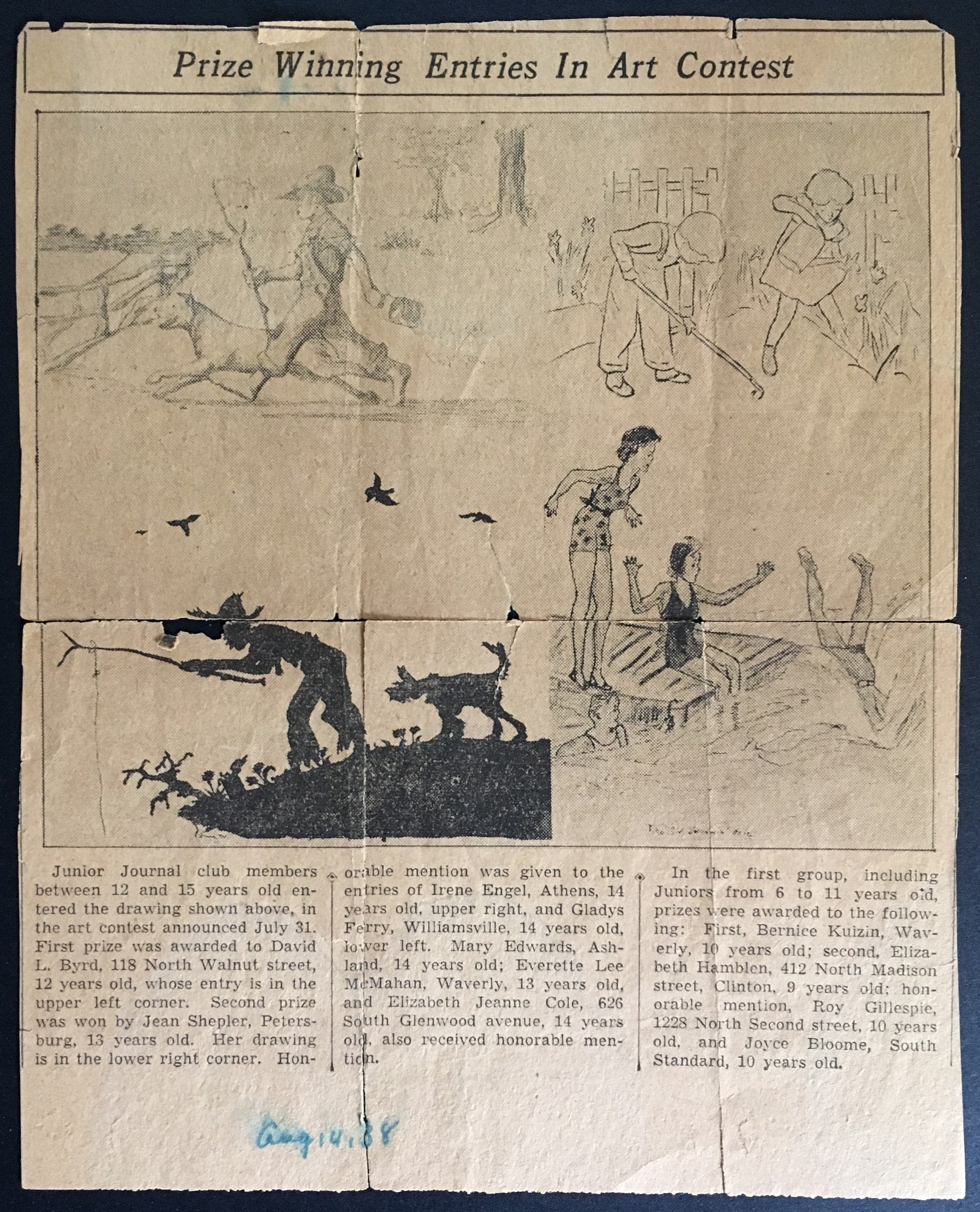
David was born in 1926 in Springfield, the small-town capital of Illinois. He was six when his father left home. He was 11 when his mother was forced to place her six children with foster families in the region. He was 14 when his father, having been admitted to a psychiatric hospital, was found drowned, probably a suicide. The drawing I have just mentioned is executed from memory and the artist often revisits painful episodes from childhood. If Carlyle sounded confident — but he too would commit suicide — in this letter to their mother, it was first of all to reassure her. And it was also because David had distinguished himself by winning several first prizes for drawings at an early age. His works were even published in the local newspaper. The corresponding newspaper clippings were piously preserved. Proof of recognition and also proof of popular faith in social emancipation through art or entertainment, with the celebrity of Walt Disney on the horizon.
* * *
Approximating appearances
One of these childhood drawings depicts a family Thanksgiving celebration. David is 12 years old. Franklin D. Roosevelt’s America is recovering from the Great Depression. Hope is alive, although, in these foster families, children are sometimes mistreated in a general climate of violence. Another prize-winning drawing in the same year, 1938, depicts a boy the young draftsman’s age in overalls and a large hat walking barefooted with a determined stride beside a dog in a bucolic landscape. A fence is inserted two steps away, between the foreground to which the characters belong and the great landscape, but it is a negligible obstacle for this pair in the spirit of the imagery of The Adventures of Huckleberry Finn.
A small drawing from his maturity (SD-951), undated, returns to the same theme. The pair are again facing left, the boy replaced by an adult pulling at his dog before him on an invisible leash. The drawing seems lost on a blank page devoid of any spatial references. The dog is slender in the child’s drawing and formless in the latter one. The largely unfinished drawing by the veteran artist is not one of his most remarkable, but it is characteristic of his style. Small tremulous lines come together to approximate the appearance of the human and the animal. The outlines of the child’s drawing were firm, and the silhouettes set down strongly. Those in the drawing as an adult are uncertain, transparent. In the first, the movement is noticeable. In the second, it is barely suggested, mainly due to the edginess of the draftsman as he searches for the motif he is trying to grasp from nature. Shadows add to the realism of the boy’s drawing. The one by the adult does without them altogether. There are in fact many differences between instantaneous drawings of this kind and those which the artist conceived as preparatory drawings.
Byrd produced thousands of drawings, without developing all of them further. But whenever he saw material for a painting in one of them, he would repeat it as many times as he felt necessary. From his experience as a bartender at the Coney Island amusement park, Byrd came away, for instance, with no fewer than 15 preparatory drawings for five paintings of the same composition, made between 1970 and 2002.17
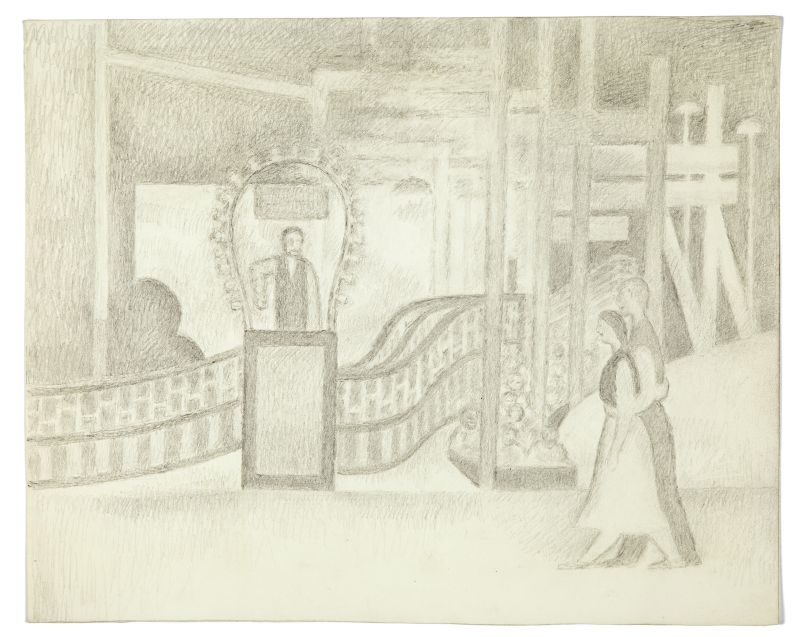
The drawings without development are no less interesting — the book is full of wonderful, isolated drawings. They have the immediacy of the thoughts that we fail to remember, but which can have the intensity of a flash of lucidity, and we forget them because lucidity… can be disturbing. Now it is out of this multitude of thoughts that we compose the idea we have of the real. The real does not have the sharpness that is attributed to it. It is a haphazard construction.
* * *
Please, be quiet
There are unexpected bridges between the different themes that the artist depicted, just as there are between the formless quality he gives to certain subjects, and the precision that he imposes on himself in composing his paintings. In Man in Bed, 1973 (P232), formlessness and geometry are juxtaposed.
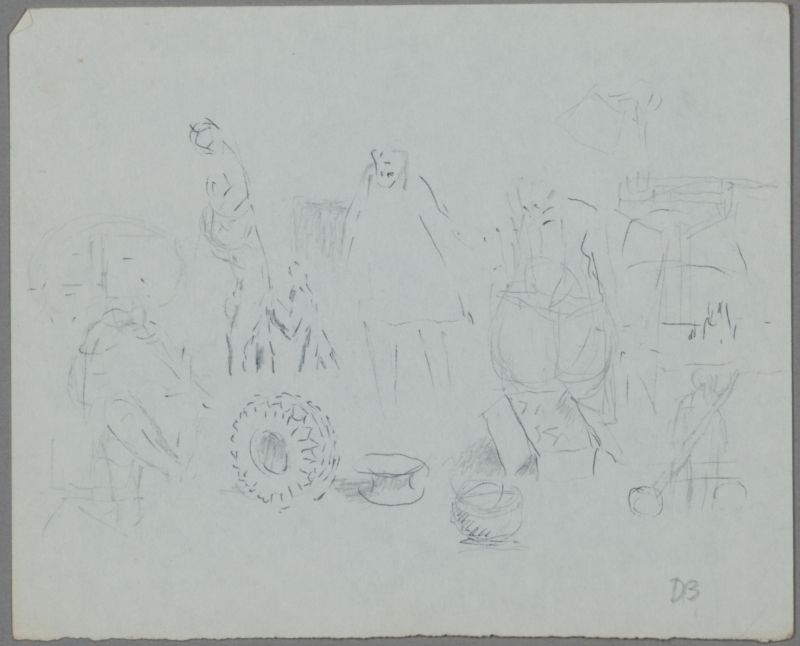
There is also an evident parallel between the more agitated group scenes inspired by Byrd’s professional work at Montrose hospital and those sketched at the auctions he frequently attended. He made more than 300 drawings of these, including some jotted down on the auction cards, between the large numbers used to identify the bidders who would brandish them at the crucial moment. What was Byrd looking for in particular at these sales? Second-hand materials for his home sometimes. But above all, he found a very large sampler of theatrical poses in the outstretched arms of the bidders, in the jostling and wrangling of the public, in the poses of the clerks handling and presenting the objects put up for sale. Then there is the triumphant portrait of this man with his arms encumbered by two busts, earning him the title of Man with Three Heads, 1999 (LS-251). Another drawing shows a headless person lifting a clock that covers his face (SD-1152).
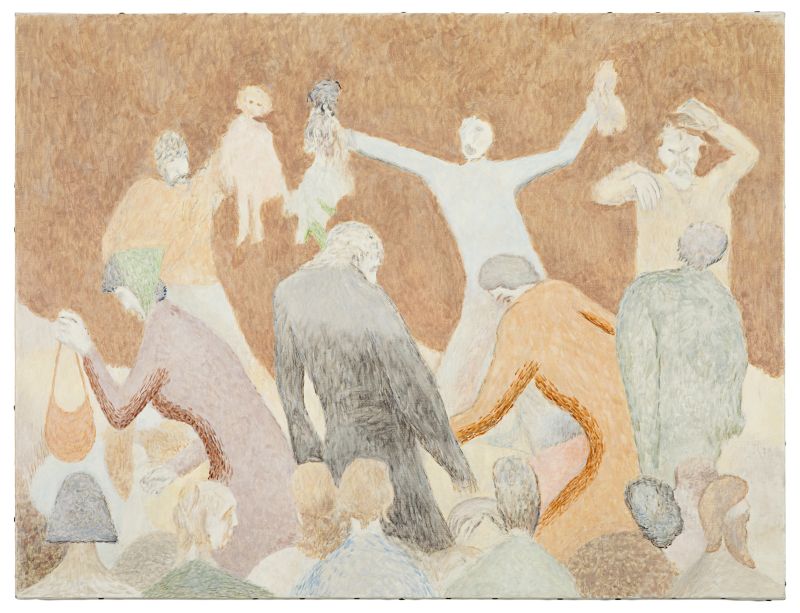
There is both contemplation and confusion in these scenes where one connoisseur religiously lifts up an object to inspect it from all angles, and others frantically snatch up highly coveted lots. There is something of a Last Judgement in all this hustle (SK6-6R), where the disorderly crowd faces an auctioneer perched on his platform like God on the clouds. Byrd observes and records. He could hardly fail to note the sign “please be quiet”18 (SK1-12R) on the auctioneer’s desk. Idlers turn up for the show and enjoy the excitement of the rivalry between contenders to purchase garden shears (SK9-26), a pair of giant augers (SK2-36R), two handsaws (LS-63), or a rocking horse (SK7-19V). Clearly these are sales of everyday consumer products, giving them a last chance of reuse after inheritance or bankruptcy. “The circular economy” is a big expression, invented by the wealthy. It is rather the display of an economy of resistance that we are seeing here. No artwork attracts Byrd to these auctions, but sometimes oddities, such as this miniature coffin that we find in a painting from 1989,19 preceded by two drawings.
* * *
Organizing Chaos
“There is a lot of psychology in the auction action,” observes Jessica Farrell. “Perfect for David to capture. There are bidding ‘wars’ and auction ‘fever.’ You walk away with a treasure or buyer’s remorse. David really studied all aspects of it, like he did at the hospital.”20 Indeed we can find similar attitudes in the climate of excitement of these sales (SK3-25R) and the chaotic situations encountered at the Montrose hospital (SD-1863). The great difference is that at auctions the attention is focused on a single action, while at the hospital the action is disjointed, fragmented between so many actors indifferent to each other, united in a semblance of order only when they have to obey the hospital rules, whose logic escapes them. Otherwise, they are scattered.
If they are caught in bizarre attitudes when they are beside one another, it is because none of them really observe the individual behavior of their fellows. Byrd explains this dispassionately: “The patient acts in a way that normal people also act but seldom reveal. Normal people are acting like mental patients, but seldom do they act that way in front of people.”21 And if some have lost all modesty, that’s partly because modesty cannot withstand the tyranny of the community, because it has been eliminated by the very routine of care. Nudity, which has become compulsory for reasons of hygiene, is no longer a matter of privacy. The right to privacy ceases to exist in such a system.
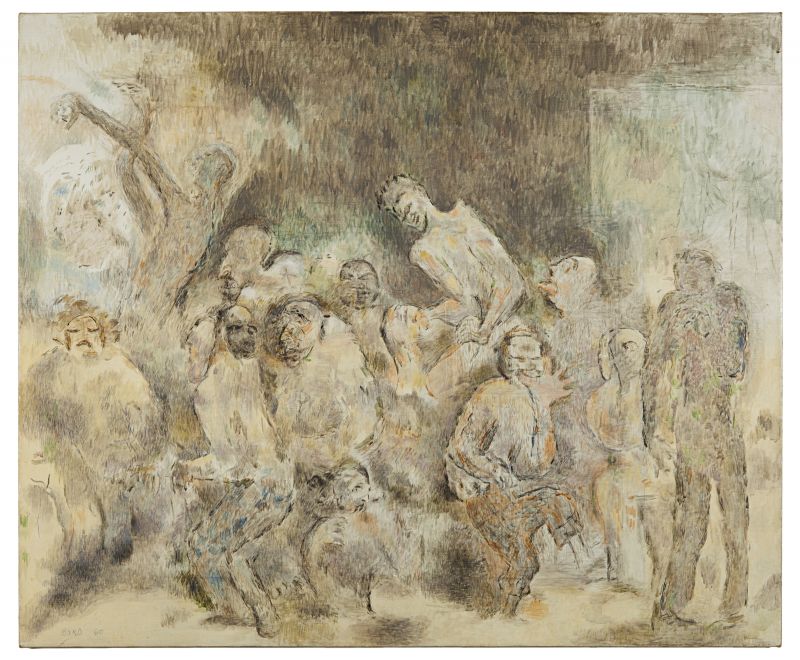
The catalogue raisonné shows that, from the many drawings reflecting Byrd’s experience of auctions, he developed 24 paintings, against the 136 inspired by his observations at Montrose. The disproportion is surprising. It highlights a difference in the artist’s relationship to the real. Auctions were always a part of his life, but their commonplace bustle meant they belonged to a part of everyday life that was not closely in sync with his work in the studio. In fact, he interpreted the corresponding paintings — whose intelligence and dramatic tension have been masterfully analyzed by the artist Merlin James22 — vary widely in relation to the drawings. The slow, meticulous work that his paintings demanded, on the other hand, was perfectly in keeping with the processes of mentally refining and recomposing those images of Montrose that haunted him long after 1988, troubling him to the point where he made them his principal subject.
It should be noted in this respect that Byrd was a highly organized archivist and very concerned with conservation. And yet he seems surprised: “Strange that some people saved van Gogh’s 800 paintings and 700 drawings when he only sold one in his lifetime.”23 The scrupulous inventory made by his estate brings to light many drawings that have barely been sketched, and not just on the backs of the more remarkable pages of the sketchbooks. If Byrd kept so many drawings (perhaps all of them: he clearly identified with van Gogh), it was because, apart from the interest of the works he thought of as completed, he saw this whole corpus as a basic resource for his perpetually developing oeuvre. He saw it as material conducive to reworking and introspection, whatever the theme it dealt with. In this way it might sometimes take several years before an isolated sketch was able in his mind to become a preparatory drawing for the great undertaking of a painting.34
Montrose V.A. 1958-88, p. 137 (BK-137) (detail)
* * *
Isolating, abstracting
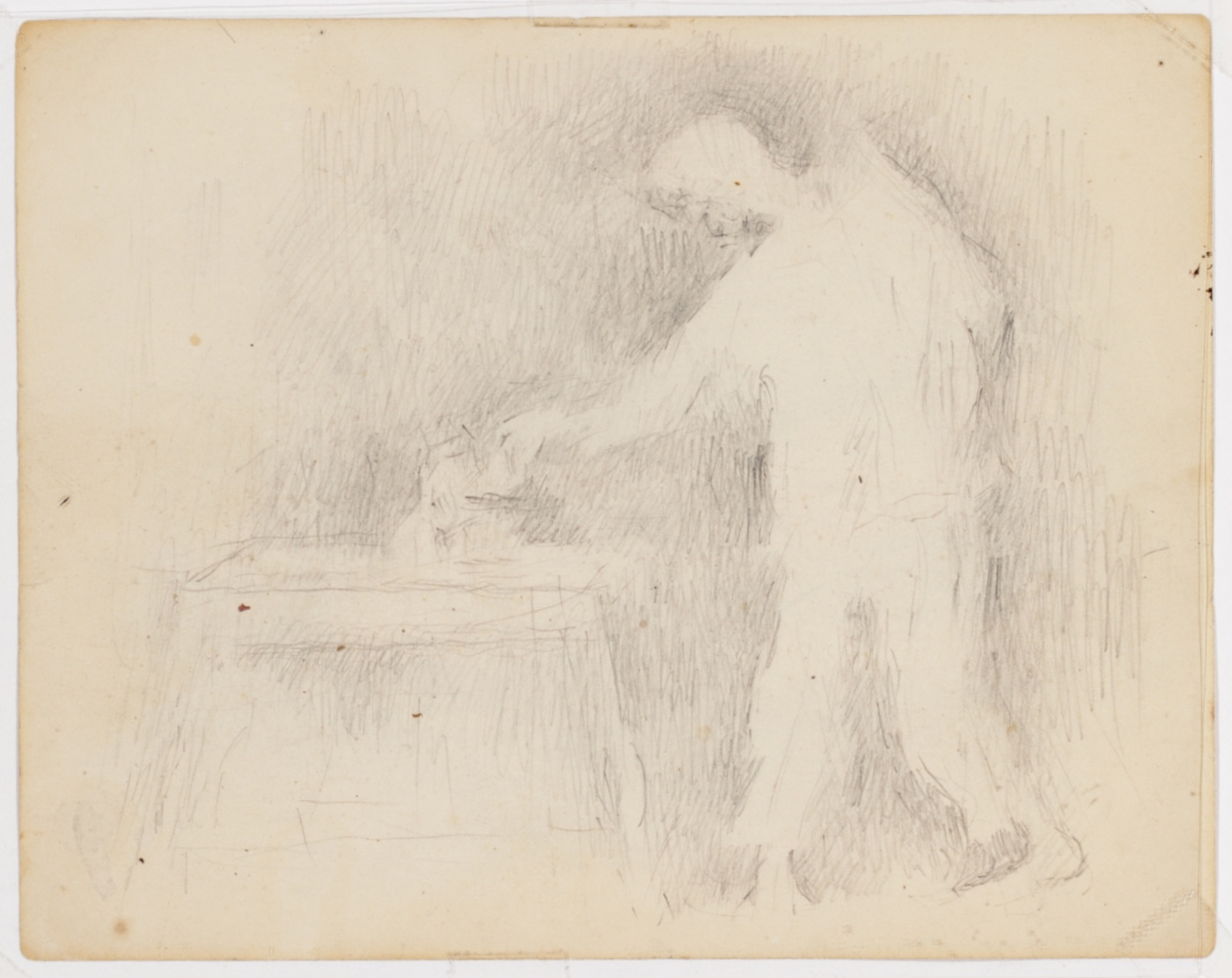
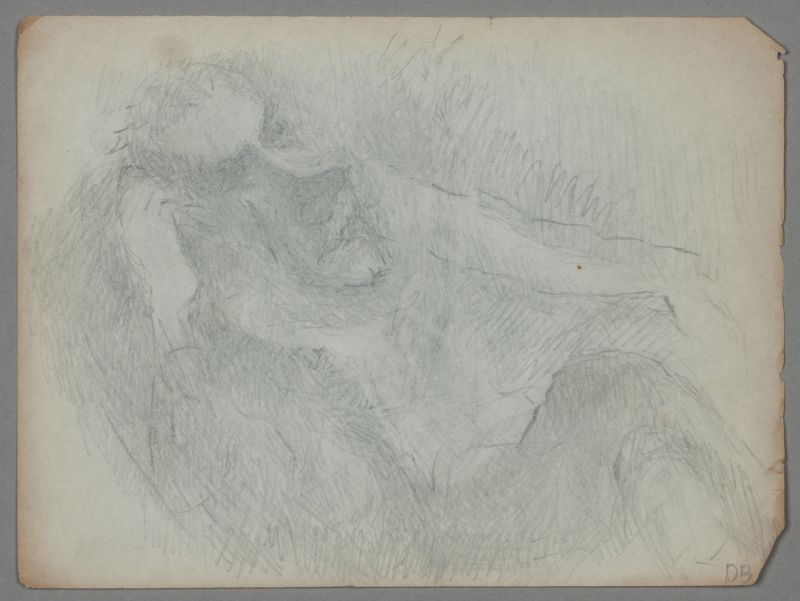
The drawings generally have the tenuousness of sudden apparitions. Emerging from a peripheral shadow, spectral silhouettes or hollow faces sometimes appear in counter-form from backdrops penciled in with dense hatching (BK-128, BK-137). Yet, nervous though it may be, the pencil mark is rarely deep in Byrd’s work, and the figures are even more rarely surrounded by a continuous outline (like the monogrammed drawing with the caption “nurse,” BK-62, from page 62 of his book). The crisp, repetitive movements of his wrist are tight, and the grain of the paper stands out more in the sketchbooks… Likewise, his pictures are painted with small touches, and never with flat fields of color. However, passing from instantaneity of perception and the impulse to reflective construction, a different way of structuring his images appears with the transition to color, inlaying the forms and the figures. The spatial sense and legibility of the scene are heightened, and color makes it possible both to assert the general composition and to distinguish certain parts of it with an almost independent treatment.
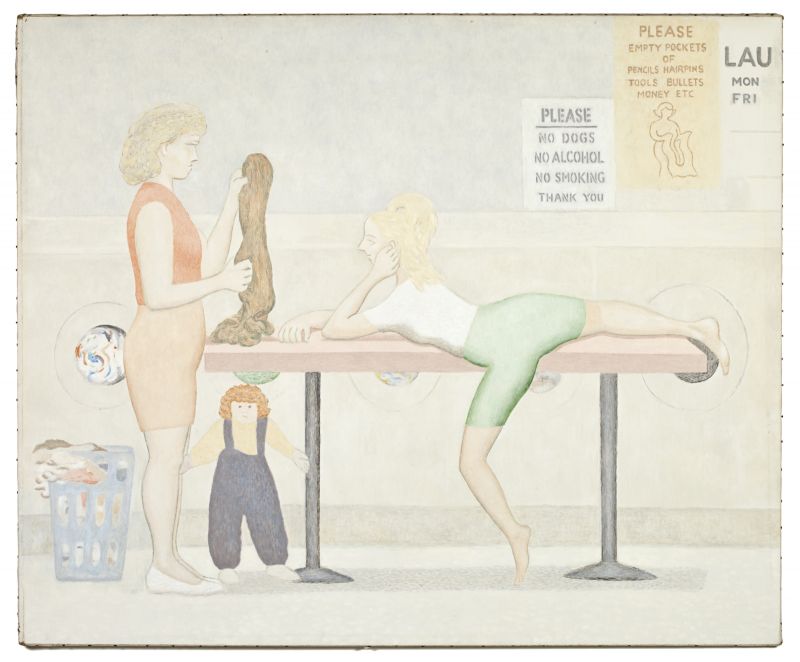
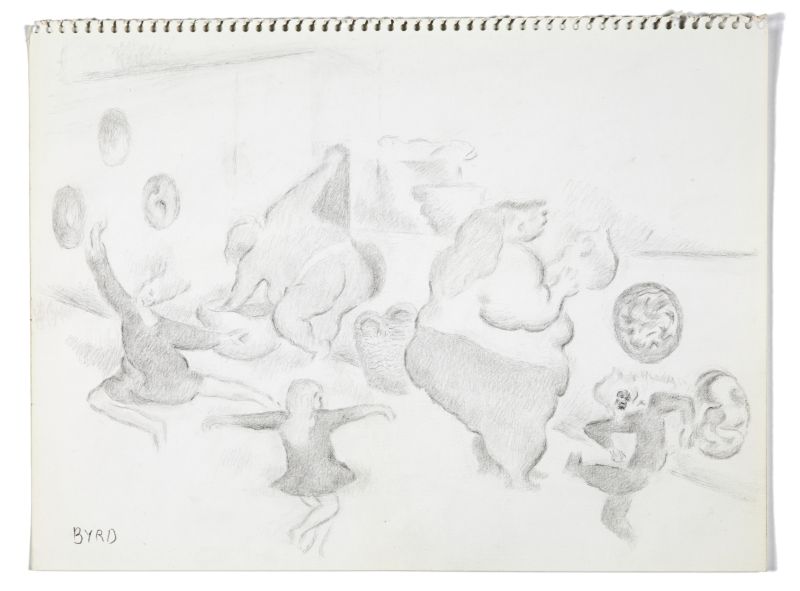
For example, the detail of the green shorts of the figure who gives its title to Woman on Laundromat Table, undated (P286),25 is completely abstract or insignificant if isolated from the rest of the painting. Subtle color gradients of the same green trace its outline and give it a very artificial form. But all around are other details, as in a jigsaw puzzle, that reinterpret the real situation observed by the artist while his washing was swirling around, eight miles from home, in this laundromat, in the village of Sidney, in which he liked to loop together the portholes of the washing machines, usually neatly aligned, even imagining sarabandes (LS-89, SK4-56L) as wild and eventful as when he set the patients at Montrose dancing on canvas or paper.
* * *
Mental cosmos
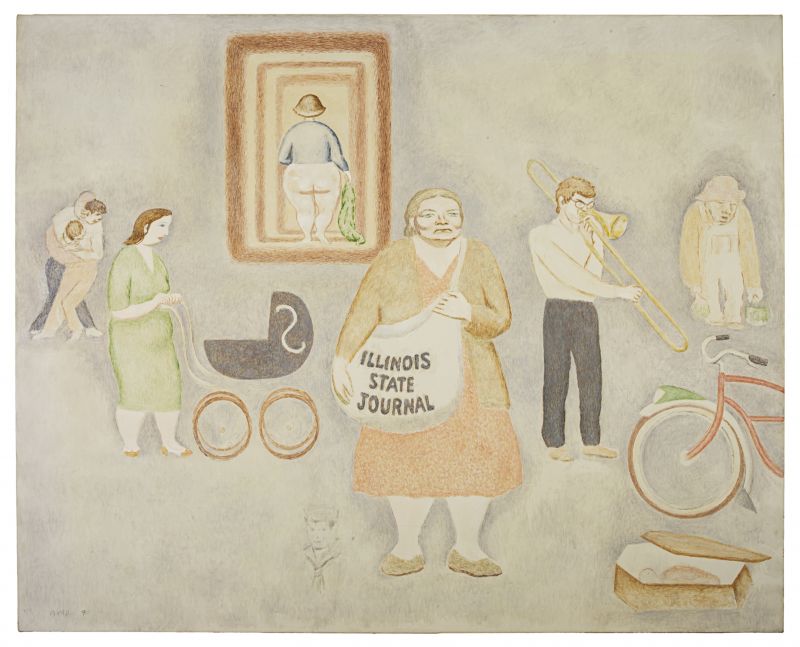
This mosaic or jigsaw pattern is nonexistent in the drawings. On some sheets that group together notes drawn in different settings, the random organization of fragments without any thematic or spatial coherence recalls those frescoes, insipid and all identical, that multiply clusters of edifying allegories of all kinds on the facades of many public buildings, as in the program of numerous socialist-realist decorations. And while Byrd’s far from improvised paintings are subject to the obligation of descriptive and narrative verisimilitude, four are exceptions by adopting this type of “muralist” arrangement, without any spatial unity. All four draw on early memories. Three are childhood memories: Between Services, 2013 (P209), Time Keeps on Running (P217, cf. LS-76), painted the same year, and Foster Family, 1990 (P200), with its preparatory drawing very significantly captioned “Ghosts, Family Life” (SK8-1R). The fourth of these “cloud paintings” is Smiling Men and Dead Men, 2005 (P198), an evocation of wartime memories, on which Byrd commented: “War is always with us.” The ghosts of our memory float like this, titillated by our imagination, in a mental cosmos freed from earthly gravity as well as from all factual linearity and causality. And unfathomable like this, obsessions jostle in the minds of the patients that the artist observed with real but restrained compassion over those thirty years.
To measure this restraint, one only has to look at a group photo taken at Montrose. A registered nurse in uniform, all smiles, holds two patients upright with linked arms, one happy, the other staring at the camera with a blank, stubborn gaze. The three other patients seated in front stare at the photographer, looking identically lost. Of the seven people gathered in two rows in this photo, only Byrd, in civilian clothes, standing on the far left, hands in pockets, refuses to play the game. The photographer’s flash is reflected in his spectacles. His eyes are closed.
But this detachment can be explained differently. Several times in his book, the painter of Sidney Center is concerned about the use of drugs for treating psychiatric disorders. He paints an understated picture of patient dependency in his oil on canvas Man Downing his Medicine, 1990 (P167, see also SD-1232 and SD-1233), but is unsparing in his criticism in Given Meds, 1992 (P148 and SD-1229R). This scene of force-feeding, of forced communion with the chemical host, has obstruction, restraint, constraint and submission – they’re all here.
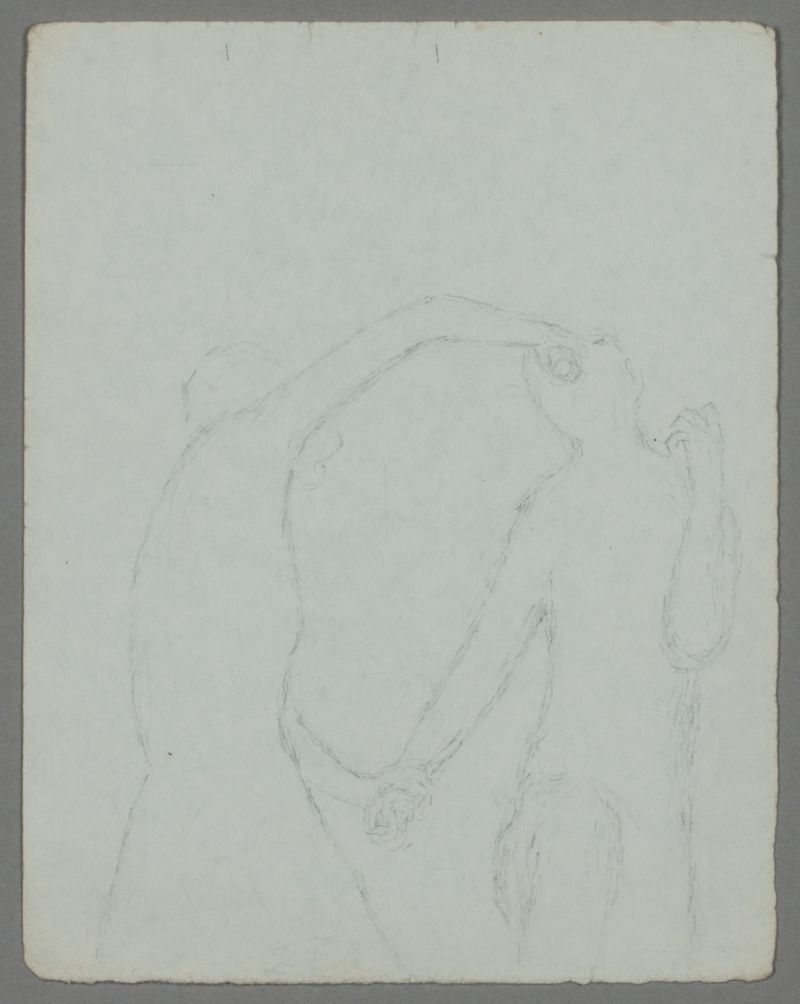
And then there is compassion in the hundred or so paintings and drawings depicting patients struggling to get dressed or undressed,26 their faces often disappearing completely under the garments hampering them. And in the same way they disappear completely in the roughly 200 works verging on abstraction, depicting the same individuals lying in bed, covered with sheets with geometric forms, some of them evoking mountain landscapes with steep slopes.
Painting is ostensibly “metaphysical” with de Chirico, whom Byrd studied carefully (Underpass, 1986 (P242)), but in the latter’s work, above all, it is meditative. It lacks the ostentation that the other adjective, which William Carlos Williams execrated, would confer on it.
* * *
Not satisfied
“Sometimes, you get mad because you can’t get any idea,” Byrd says in Andrea Hull’s film shot shortly before his death. He then evokes how he fished for ideas when he went to the village once or twice a month to do some shopping, wash his clothes and top up the fuel tank of his all too thirsty Chevrolet Blazer. Like the laundromats, the filling stations with their modernist canopies were very inspirational. An orderly geometry is broken up by the interruption of the human presence and the interlaced hoses of the gasoline pumps. The gestures of the pump attendants hooded in the rain, tugging at the nozzles to serve customers, have the theatricality that can be found everywhere in Byrd, like the members of the Ku Klux Klan in Guston.
But who before him saw any theatricality in these ordinary scenes? Who else looked so attentively at the diagonal perspective of this supermarket in Sidney housing the automaton of an elephant ride at 25 cents a minute? Children who were able to ride on the animal’s back many times would have had their fill as they grew up. Not Byrd. When Jody Isaacson dares to ask him if he is satisfied to have led a solitary life for twenty-five years, he replies: “not satisfied,” then he stammers: “existing.” So, the supermarket as a space for socializing? Probably a rather mediocre one, but it was definitely an observation post.
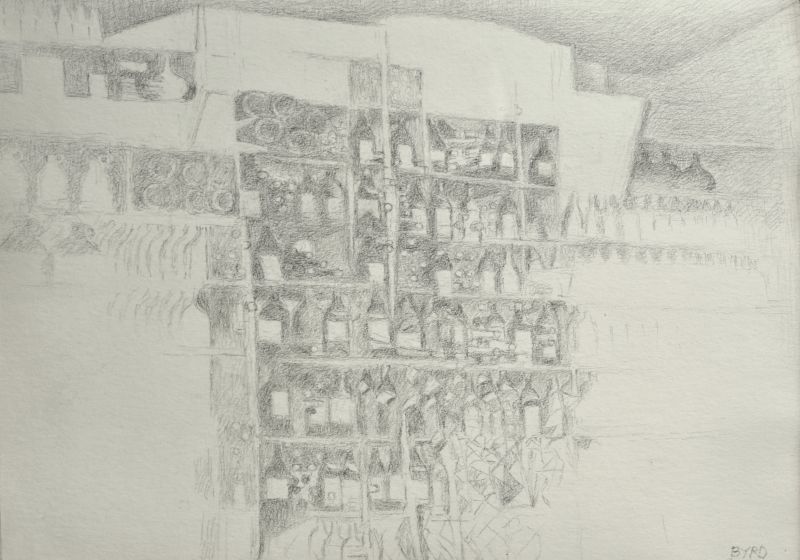
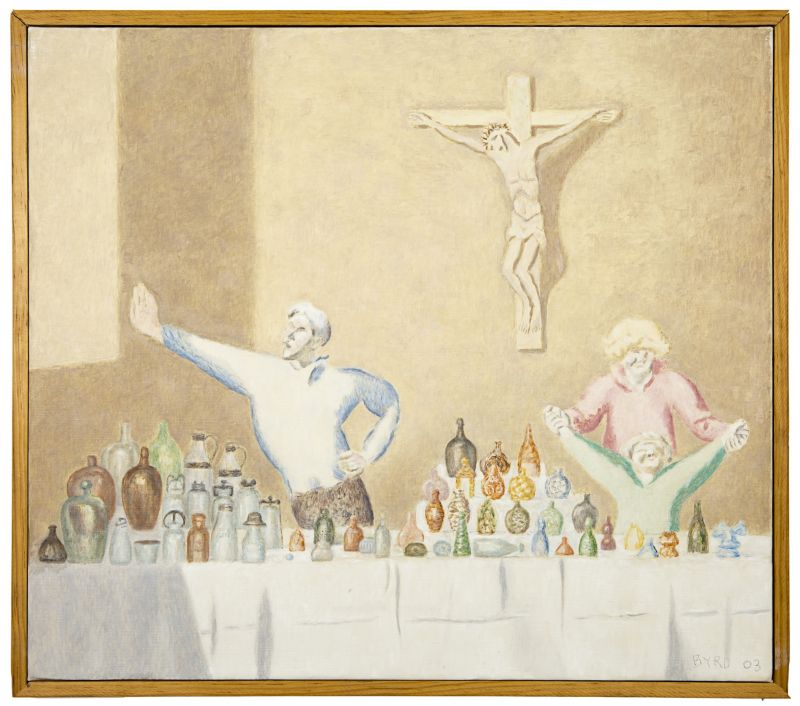
At the same time, Byrd maintained his sociability through the collection of bottles and preserve jars that he built up over the years. He came into contact with a community of enlightened amateurs while browsing various bottle dealers’ showrooms for these objects. A frank smile appears on his lips in a photo taken at one of these shows. In this small world of collectors, Byrd was well known; he had specialized references. And we can assume that this passion had deep roots. Two of his early paintings, dated 1948 and 1950, depict the shelves of a wine and liquor store on Madison Avenue, New York, where we remember that he worked! The 1950 painting, Liquor Store (P22), was distinguished the same year by being reproduced in the magazine Art News to illustrate an article entitled “Can Painting be Taught? Ozenfant.”27 This is proof that the painter-teacher — whose still lifes meticulously depicting glasses, cups, jugs and other domestic vessels favored his purist doctrine — truly considered Byrd a promising artist, and at least one of his most brilliant students. Alas, it was this painting, in the year of this publication, that caused him to be rejected as derivative when he contacted the MoMA.
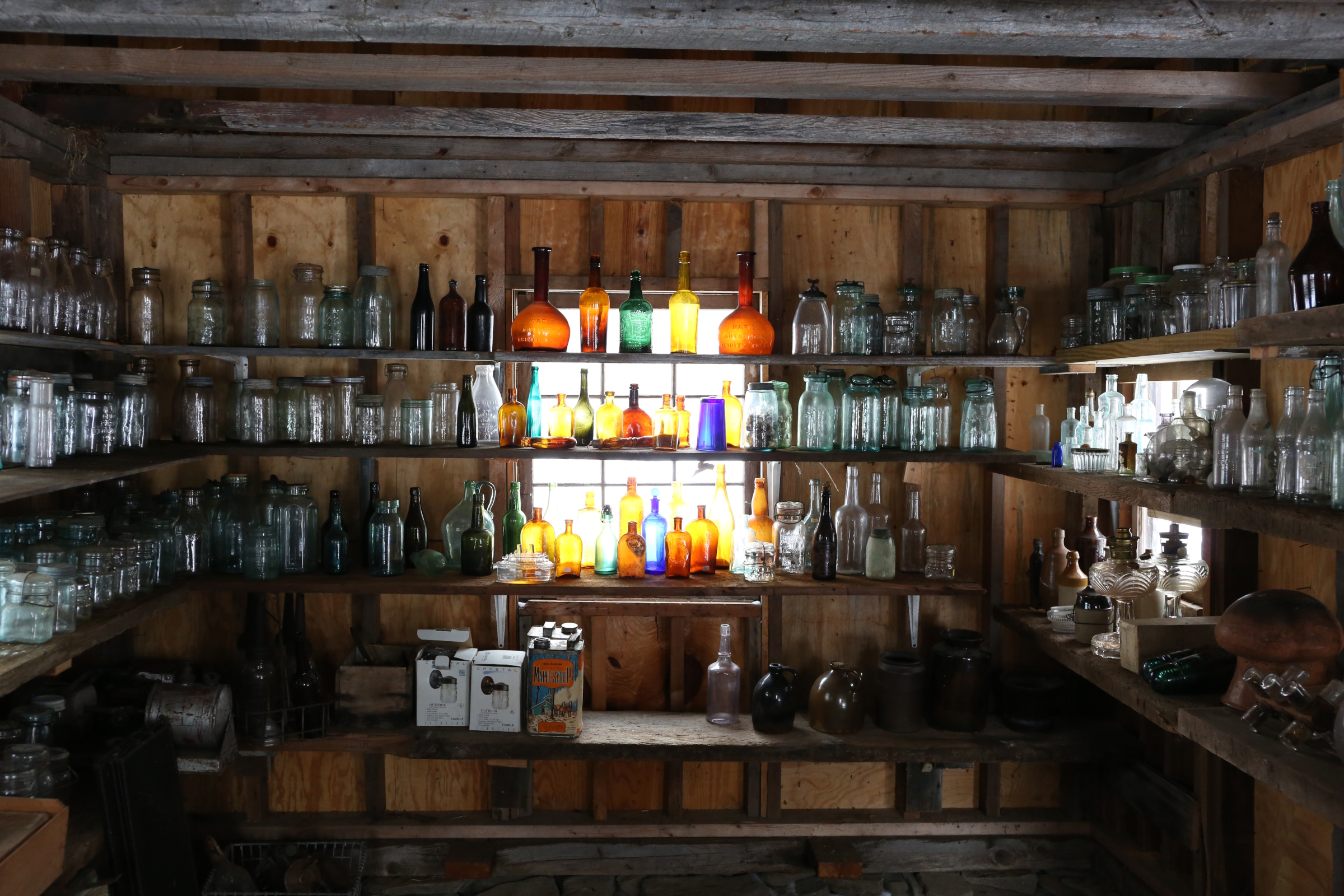 Byrd House - bottle shed (House 9) |
* * *
Pell-mell
“He was the best teacher in my life,”28 said Byrd, who did not have many. But was Ozenfant’s influence so decisive? The paintings suggest that it was quite enduring, with their extremely precise construction and register of colors in attenuated and chalky hues, of the same tone as the glass of the jars in his collection (“Like the rare color but too expensive,” he laments in a letter to a fellow bottle collector.29) However, for a man who was compelled to a certain restraint by his modest income, the mixture of white with color also had a financial advantage in painting. Byrd studied under Ozenfant for less than two years, then failed to keep in touch with him after he returned to France, yet the French master had a lasting influence on Byrd as a painter, although the drawings were quickly freed from his lessons, his work being enriched by the dialogue between the two sometimes divergent practices.
Byrd as a draftsman allowed himself more distance than Byrd as a painter, in which he excluded improvisation, as in the artists usually mentioned in relation to him: Hopper, Chirico, Balthus or, of a different caliber, Andrew Wyeth, George Tooker… To these we can surely add Thomas Hart Benton, Norman Rockwell and, among the great European moderns, in whose work Byrd had steeped himself, Modigliani… and Ensor, perhaps – but who can ignore them? He himself cited Botticelli, Michelangelo, Velázquez, Rembrandt, Goya… Whistler, Degas, Renoir, Van Gogh, John Singer Sargent, Seurat, Braque, Stuart Davis… And: “Nobody would paint a Cezanne or Constable […] but it is possible to be another Pollock or De Kooning or even Picasso there,”30 he wrote to his dear aunt Emily in about 1989, following a trip to Manhattan.
The game of finding influences is as endless as the game of resemblances is murky. Looking more specifically at Byrd’s drawings, his approach “by approximation” makes you think of Bonnard or Giacometti; his multifaceted treatment of landscape and certain figures, of Lyonel Feininger; the choreographic postures and the simplification of forms, of Oskar Schlemmer… And further comparisons can be made with artists whose work Byrd certainly did not know, such as Zoran Mušič,31 Roger-Edgar Gillet,32 Marwan,33 or early Baselitz and many other Expressionists.34 That said, it is a singular aspect of Byrd’s painting that he refrains from any demonstrative gestural or tactile effect, even in the most dramatic subjects.
In this respect, Byrd and Artschwager telepathically came together again in dealing with the theme of suicide, two years apart. In depicting both men falling headfirst into the void, neither indulges technically in a morbid complacency. As usual, the layer of pigment is thin and the touch very carefully applied in Suicide, 1996 — Byrd’s painting, acquired by Greg Kucera, who immediately offered him his first professional exhibition. Artschwager, on the other hand, used a preparation of his own for his Falling Man I, 1998: rubberized horsehair, a padding material, as if to tone down the silhouette, make it less real, and cushion… the shock!
* * *
Invariably
Byrd’s output of paintings was remarkable for its formal constancy. From Brooklyn Park, 1950 (P3) until his last painting, Byrd never deviated. In Brooklyn — where his mother had found a job as a cinema usher, enabling her to reunite her children when David was 15 — the park is frozen, completely devoid of human presences. The trees are bare, reduced to their structure. One of them has only three short hairs at the top. It is a slightly twisted pole rather than a tree, or a tree kept under observation, but probably marked for felling. With its colors reminiscent of the palette of Morandi,35 another famous lover of bottles, and its composition already in place, Brooklyn Park is an icy and chilling psychological landscape, although favored by a very gentle harmony.
The atypical stylization that the artist adopts in works such as the very Art Deco Balcony with Screens, 1955 (P253), the carnivalesque Two Patients, 1980 (P191), the robotic Shopping Cart, 1989 (P91), or the complete arabesque of Counting Money, 201036 (P22), does not alter the general impression that he found his vocabulary from the start, and he felt no need to change it or evolve towards something else.
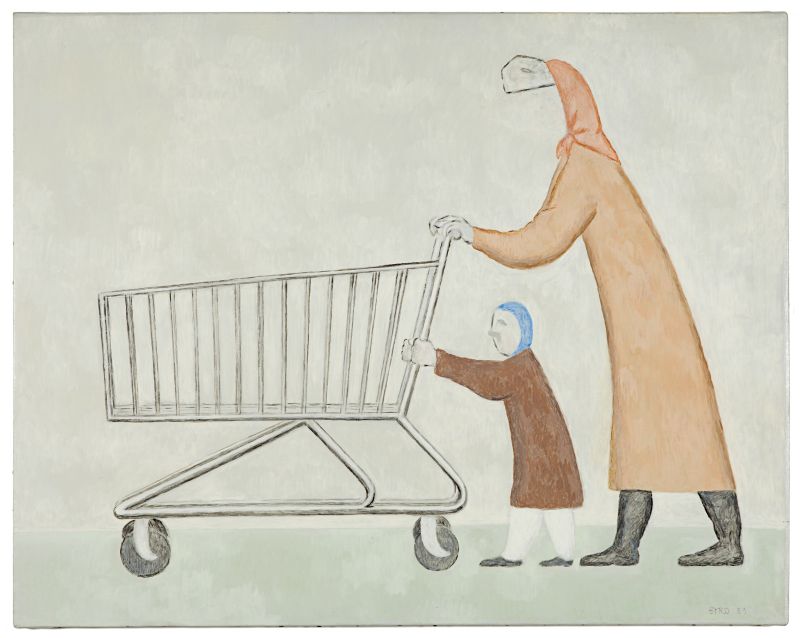
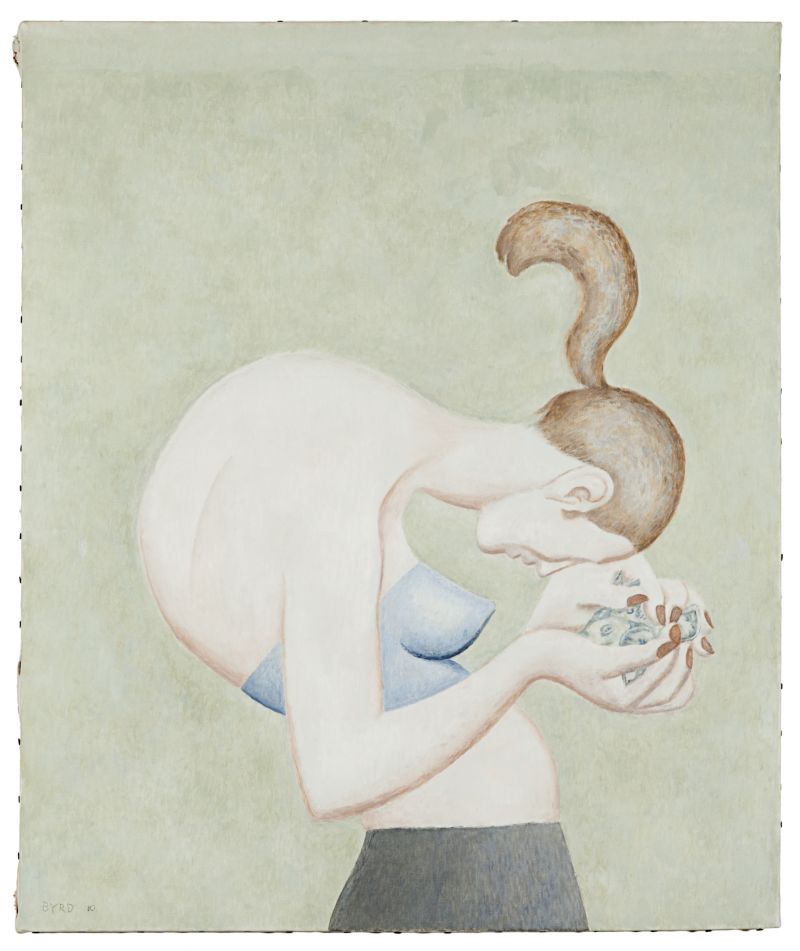
This invariability is notable in many other famous artists, especially among those considered the most radical. (The question of evolution did not arise for Josef Albers from 1950 until his death in 1976.) It is also evident among outsiders, but Byrd is not an outsider. Now, if Byrd’s style was so invariable for more than sixty years, consequently or not (how to decide?), it has something that is impossible to relate to the chronology of contemporary art of his time, to which he hardly exposed himself. But this doesn’t mean his work is anachronistic.
Even though an artist may be an exception among his contemporaries, if he at least has the power of the exception, every artist is of his time. Fra Angelico is not timeless, as one says. And you would have to be careless to credit Byrd with such a well-worn compliment, though much of his imagery adheres to the “eternal” America of the backwaters, of average cities (average in all respects), and country places, frozen in the clichés of the ’50s and only exceptionally taking on the air of a domestic Far West. Byrd, in passing, resolutely strips these clichés of everything picturesque, as in Making Bed In Coal Country, 2002 (P45 and LS-93R), where a painting within a painting (a New Age Christ posing peacefully before a sunset) hangs above the unmade bed, on which – surprise! – lies an enormous revolver. In the absence of eternal life or a gold rush, coal will be exploited, and then shale gas!
* * *
Column without a future
So, an unvarying painter, yet inflections in his work can be observed from one sketchbook or pile of drawings mingled with another. Except that we cannot deduce any progression, since most of them are not dated. Moreover, not all of them are signed or monogrammed. And a qualitative assessment did not always guide the artist in deciding to authenticate them in this way, because many outstanding sheets are not marked.
About 20 realistic drawings on tracing paper, unique of their kind in this medium and of great technical virtuosity, can be considered separately. Studies of group portraits, rather hectic street scenes captured in the working-class neighborhood of some big city (Brooklyn?), all have in common a dark tone. A self-portrait of the artist as a young man, in the same style and the same medium, enables us to date them approximately. Byrd did not continue along these lines.
Many of the sheets are filled with details difficult to identify, either because Byrd accumulated drawn notes of various origins, or as a result of specific observations (an antique dealer’s store, the interior of a supermarket, SK4-29, SK7-34R), or because the nature of the subject invited him to do so (a vision of purgatory, SK1-14V). The sheet of paper was a surface available, ready to receive everything of spontaneous interest to the artist, in life, his memory and his imagination.
A plumber stuck under a kitchen cabinet repairing a leak under a sink, with only part of his body protruding, for example, gratuitously presents him with an interesting situation (SK9-75, SK9-76). But, though his painted oeuvre is rich in other eccentric poses, this one was ultimately judged to be insufficiently intelligible or too anecdotal to be exploited beyond these two sketches.
A series of sketches reveals a temporary attraction to knobby tires (SD-842, SD-848). Byrd did not collect them, but their abstract and repetitive tread patterns, made for gripping the road, caught his eye. There may be something of this left in his version of The Endless Column, made up of a dozen wheel rims that the artist stacked in his garden, Rims (SC/A-36),37 but it was never worked up into a painting.
This brings me to the end of the inventory of the leads not followed.
* * *
Half-doors
What boundary lay between the drawings and the paintings? To the list of Byrd’s influences can be safely added the illustrators and cartoonists of The New Yorker, of which he was a loyal reader. This influence, however, appears more in his drawings than his paintings. Certainly, in the case of the unidentifiable figures covered in soapsuds, found in five pictures (P113, P141, P177, P265, P268) painted from 1989 to 2012 based on his experience at Montrose, these mutant silhouettes may seem to have come out of a fantasy comic strip. But if in his abundant graphic work, you can sometimes find a pinched nose like Nixon’s (SD-34) in the style of caricatures in the American press, you won’t come across any in his paintings. (Philip Guston turned the president’s nose into something far more trivial in his Poor Richard series of satirical drawings from 1971.)
The temptation of the grotesque does not enter so readily into his two art practices. In the very stirring laundromat scene, reproduced almost identically in the two drawings mentioned above (LS-89, SK4-56L), realistic silhouettes (two young dancers with graceful movements) coexist with others that are typically cartoonish (an excited elf with an ape-like face and two monstrously fat housewives). However, from these very accomplished drawings, with such contrasting features, the painter retained only the one with the realistic characters for his rather too quiet painting Imagining the Dance, 1989 (P80).
A theatre of the absurd is being played out everywhere, provided we know how to see it. This dimension is particularly evident to an outside observer of the everyday life of a psychiatric hospital. Byrd was not this “outside observer.” He was a seasoned observer on the inside, but he was able to distance himself sufficiently for the time it took to make a sketch, shedding the habit of his professional routine or extracting its essence. And his work always retains a note of humor, even amid the tragedy.
So, in his book, he accompanied the reproduction in colored pencil of his painting ½ (half) Door, 1985 (P89), with this remark: “Half doors were put in so patients could have contact and visual access to nurses’ office. Full door taken off. Several hyperactive patients climbed over the half doors causing the full doors to be returned and used if needed.”38 In this way, in a much earlier painting, also reproduced in his book, he lingers on another rather similar detail of interior design, incongruous but highly representative of the oppressive sense of obstruction felt at Montrose: a table placed across an open door to bar access (SD-1296, Table by Door, 1969, P145).39 No comment. This picture condenses the absurd and the tragic with the economy of a “disquieting strangeness,” to quote a specialist. It concluded the hanging of the exhibition devised by Matthew Higgs at White Columns, NYC, in 2019.40
* * *
The Invisible Man
In Chapter 3 of his novel The Invisible Man, H. G. Wells represents his main character, who has not yet revealed his evil nature, feverishly unpacking his experimental materials. The prolific author then greedily details a collection of bottles of all sizes, shapes and colors, made for all purposes. He entitled this chapter: “The Thousand and One Bottles.” Surprisingly, he did not think of establishing a metaphorical link between the invisibility of his character and the transparency of his bottles.
In January 1984, Byrd unusually confided in the same letter quoted above: “Was attracted to old jars in small way about 15 years ago. […] And about the painting, I thought it was something different but also connected to bottles.”41
I don’t collect jars, but when there’s nothing left in them, I wash them and find it hard to part with them. What I like about standard jars is precisely their universality. They’re all the same because they have reached an unsurpassable level of simplicity and perfection. Please excuse this personal intrusion. And David Byrd would not have agreed. He collected specimens that were very special in shape and color. And he would have rightly found these observations which interest no one inappropriate (“It is, in general, a large question to know whether it is lawful to act by means of a personal fact,” Kierkegaard wonders42), but which enable me to make another one.
The omission of the personal pronoun I is common in ordinary statements and correspondence in English. It makes for concision and enables one to get straight to the point. Impersonality is also a good thing in professional documents. Finally, text messages have done much to encourage this penchant for economy. However, this omission in private correspondence acquired a manifest character of voluntary effacement in a person as discreet as Byrd. In his case it was almost systematic, as if, not content with living in seclusion, he sought to make himself invisible.
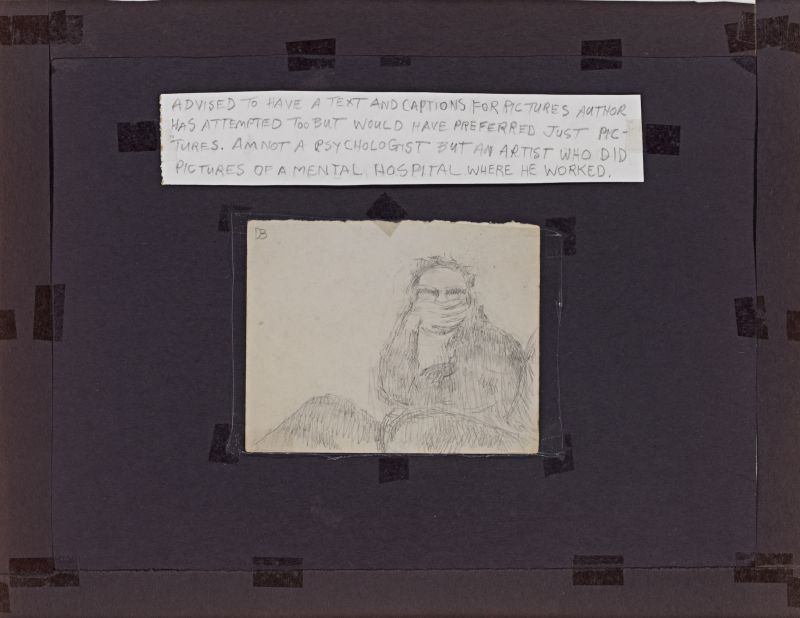
“Am not a psychologist, but an artist who did pictures of a mental hospital where he worked,”43 he advises. No doubt Byrd had to make himself invisible to capture everything he filled his sketchbooks and drawers with. “Asked a psychiatrist if the voices of God in the Bible were hallucinations and he said positively yes.”44 Voices that came out of nowhere? Impossible. Many of the drawings confirm his skepticism (“God Lies” SD-518) and his scathing attitude towards all religion.45
* * *
The Matter of Memory
Memories are invisible matter. If Byrd did not work from photos, or if he very rarely borrowed ideas for images from magazines, it was because he was primarily interested in the exercise of memory. A selective memory, necessarily and significantly, since the artist retained nothing, for example, from his failed marriage (1967-77) to a nurse at Montrose, other than the regret of having, on their separation, had to sell the old stone house in Washingtonville where the couple had settled in. “Funny you can live so long with someone you don’t like. It was only because the house. I loved it. One could express himself in so many different ways. It was something you could work on like a work of art.”46
As he then built his house in Sidney Center from scratch, definitely a major work, patiently salvaging materials from ruined properties in the abandoned neighborhoods of Newburgh and… Washingtonville (!) and just as he furnished it and equipped it at multiple auctions, Byrd delves into his memory to extract the useful and necessary to his work as an artist. Painting and drawing from memory may simply make visible a clearly identified motif, but one that has escaped the view. Memory can then be compared to a muscle exerting traction to bring out the motif in question and place it in full light.
Roy Lichtenstein, who ten years before Byrd and Artschwager, was one of Ozenfant’s first students in New York,47 would be more impressed at Ohio State University by his professor Hoyt Leon Sherman, who taught using the “flash room.” This consisted of having students draw from the image of a model on a slide projected for just a few seconds. However, this method differed little from Ozenfant’s, according to the article in the magazine Art News cited above: “Ozenfant’s school is probably the only one in the world where the student is asked to turn his back on the living model. Actually, the figure must be drawn from memory, with the model referred to only at brief intervals.”48
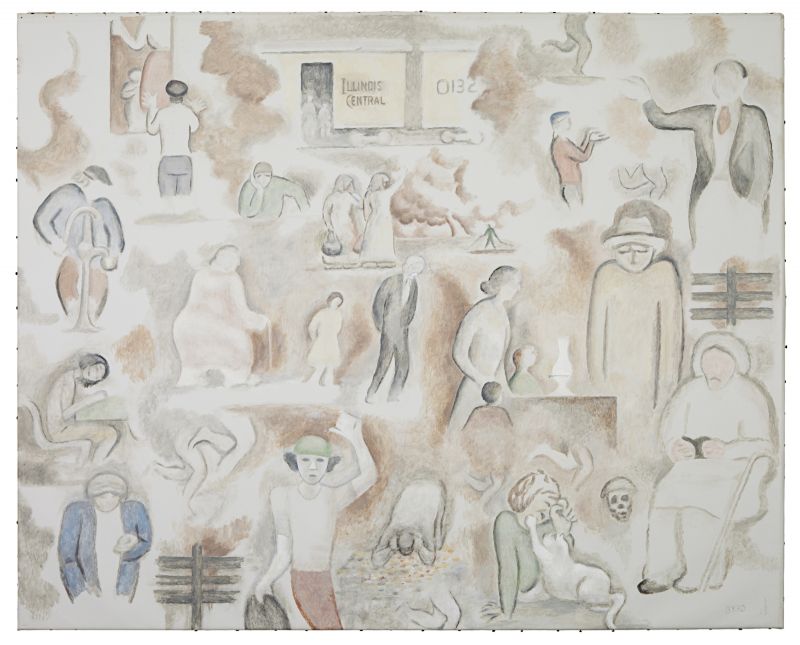
But the work of memory can also restore to consciousness situations in the past that we thought we had assimilated or discarded, freeing them from repression and oblivion. Children and adolescents in psychotherapy are commonly invited to do a drawing, to help when words fail them. Byrd’s experience at the Montrose hospital made an enduring impact on him. In retirement, he found himself more isolated than ever. Free to paint, finally, as much as he wished, but cut off from a repository of intense experiences that had nurtured his inspiration every day. So, memory always becomes more important when the present offers little distraction to its retrospective exercise.
The “muscular” exercise of memory is prosaic. It never sufficed Byrd, who did not draw or paint from memory alone in performing this function. Byrd did not just paint from memory: he painted memory, a process, and his own, making it ours, since he did not offer intimate confidences. Even his childhood memories escape from a strict and exclusive intimacy to concern us to this extent when he paints them. The individual memory is greater than the individual. He makes us aware of this. In more pictorial terms, a bottle of one volume holds more than one volume of this invisible, compressible and extensible matter that is memory. How else could the “collective memory” be contained in everyone’s memory?
* * *
Introspection and observation
Byrd produced an average of five paintings per year from 1950 to 2013, then his output took off in 1960 with eight paintings. But he seems to have painted none from 1961 to 1963, nor from 1965 to 1967 inclusive, nor in 1971. He painted only one in 1979 and 1981. Two in 2004.49 His productivity was unaffected from 1988 to 1993 when he was busy building his house. On the contrary, it was enriched with sculptures carved in wood and assemblages of a different aesthetic, which the artist seems to have rated differently,50 since none of them are dated. But some of them, placed outside his house, initially attracted Jody Isaacson’s attention whenever she walked past.51 Without any regular mathematical progression, Byrd’s output reached the exceptional peak of 25 paintings in 1989, the year when the artist was relieved of his occupational duties and set to work on the foundations of the house. Of course, the 44 undated paintings out of the 326 inventoried (13.5%) disrupt this statistical analysis. The execution of some could, in fact, be spread over several years, one adjustment after another, a final touch that has long been questioned. What caused these gaps and slumps?
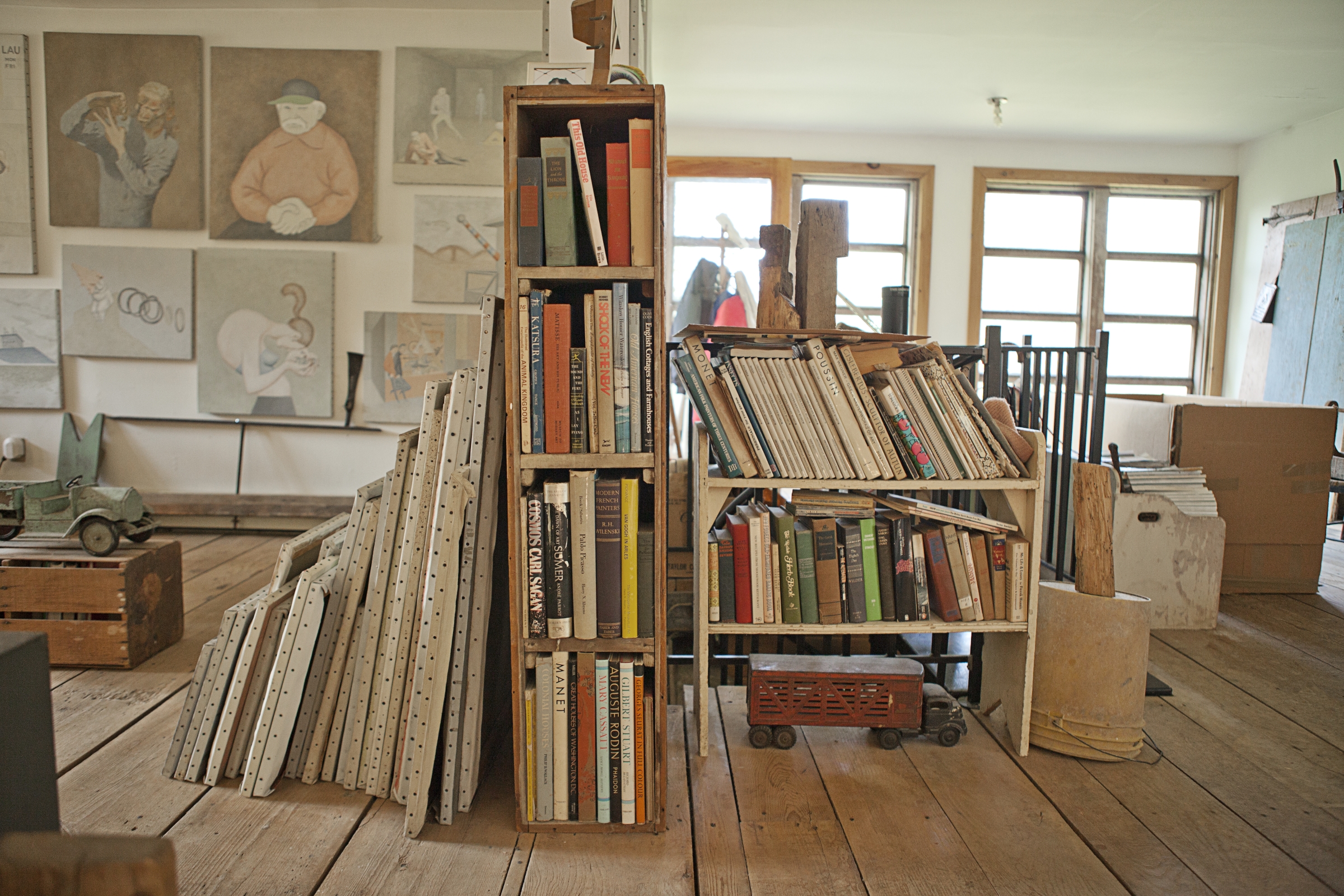 Byrd House – living room (House 22) |
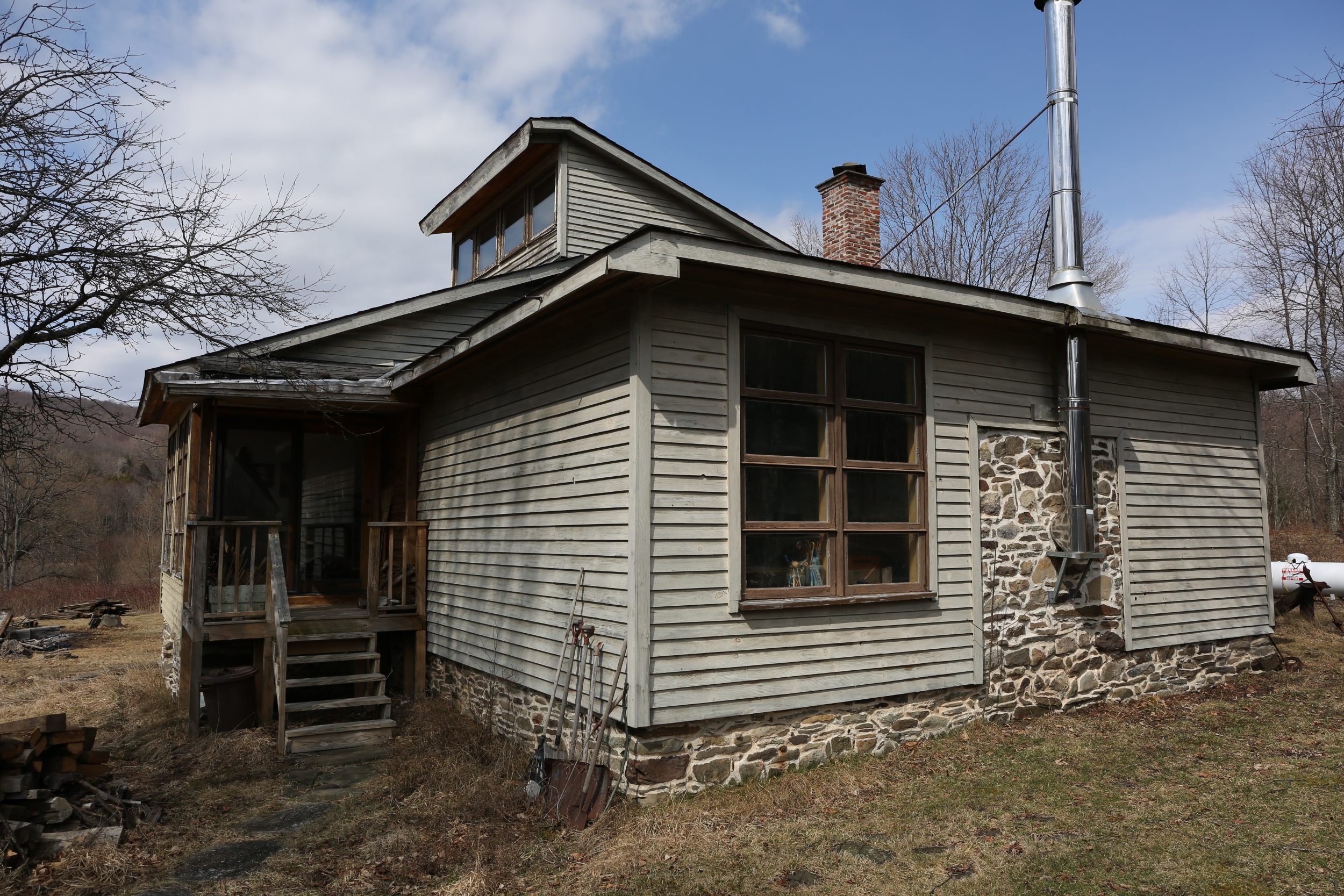 Byrd House – exterior (House 5) |
What kind of negative interferences in the ordinary life of an artist, who was not an amateur, could have affected his productivity, given that he worked so hard to eliminate all such obstacles for the sake of his art? Admittedly, ever since childhood, life had not brought David Byrd many gifts, but his work is both introspective and turned towards the spectacle going on outside. Introspection and observation come together in everything associated with Montrose — where it should be said that he lodged for more than a year after being hired — and in the mnemonic process itself that was busy everywhere. And his oeuvre remained introspective when he was only an observer of whatever offered him the animation of an auction room, the majesty of a natural landscape, the familiarity of the vernacular setting of Sidney Center, and the non-events he noticed there. How could it be otherwise? Interactions persist and increase in intensity when they are limited. Byrd looked at the world as an artist and, within the limited scope of his activities, everything served his purpose. In a letter to an insistent niece, whom he had to dissuade from moving in with him, he wrote: “I don’t have TV, cell phone never eat out, and I cut my own hair. Go to the village once a week to laundromat and grocery stores and come back (surprisingly) with two or three ideas for pictures to paint and draw. […] I need solitude more than company to paint but I doubt if others like it.”52
“David,” wrote Jessica Farrell, “was very private about his life and his paintings. None of his neighbors had any clue [that he was a painter]. It’s truly a paradox that David, who cloistered himself away from others, made all these works focused on the human experience.”53
And it is this man withdrawn from the world, who had just gone through 25 years of profound solitude, who had witnessed even more fundamental solitudes during the previous 30 years, it is this man, when he was very close to death who, from the particular to the general, confided: “I try to paint because I have the remote idea that it might serve me in my behavior to others.”54 And elsewhere, as if in a whisper: “Everything we do relates to other people.”55
* * *
Exhibiting
When in 2012 Jody Isaacson and Jessica Farrell had the idea of exhibiting local artists over seventy years old in the disused school of their village, a whole room was offered to Byrd. He was delighted. It really was the first time! And when it came to estimating the price of his paintings for possible sales, he was troubled. Without much conviction he announced the astronomical sum of one million dollars.56 Until his first gallery exhibition in Seattle, all of Byrd’s work kept him company in his home. He never seriously intended to part with it. Which, with regard to the painting already mentioned Making Bed in Coal Country, 2002 (P45), did not prevent him from confiding to Jody “I prefer this to be in a museum.”
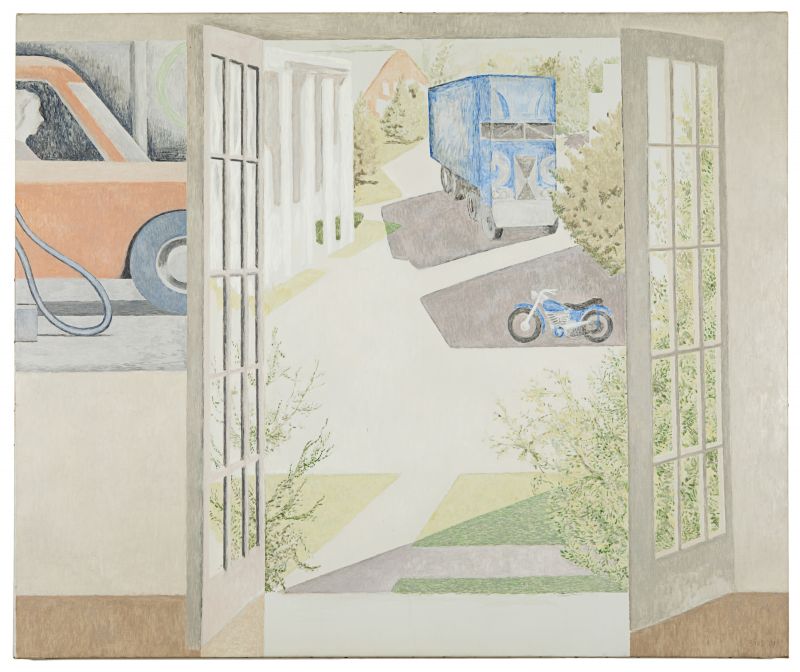
He was not, however, aware of the very well-informed Jonathan Monk’s series This painting should ideally be hung57…, which began in 2004 and stipulates that each painting in question should be displayed alongside works by John Baldessari, On Kawara, Ed Ruscha, Carl Andre, Sol LeWitt, Alighiero e Boetti, Douglas Huebler, etc. Byrd probably did not know the earlier artists Monk wanted to measure himself against. And little as we can imagine a conversation between the very reclusive and very rational On Kawara and the very smart and no less influential Douglas Huebler, dean of CalArts, it is far more difficult to imagine any kind of exchange between Byrd and these other artists. But then, let’s not perpetuate the discrimination that the versatility of the art world encourages between other people and other people’s other people.
In the absence of a dialogue between Byrd and the minimalists and conceptualists mentioned above, one could always hang a selection of his Auction Cards to the right, to the left, and on the facing wall, in the same building, on the same wall, a little too close… to some specimens of Jonathan Monk’s Holiday Paintings, c. 2009.
* * *
Zigzags in history
It’s always good to remember that Otto Freundlich, the “degenerate” and precursor of Abstract Art, supported the “modern rustic” painter (and cobbler) Gaston Chaissac. And that Le Corbusier and Ozenfant were among the first collectors of the “naïve” autodidact (and nurseryman) André Bauchant. But, once again, Byrd was not an outsider and even less a naive painter, he was an artist who could not be co-opted by the dominant trends that emerged one after the other, while solitary and imperturbable, he followed his own path from the ’50s down to 2013.
Fortunately, the chain of trends does not downgrade all unclassifiable art. His fellow student Artschwager never settled down as either a Pop artist or a minimalist. Martin Kippenberger, still admired, would perhaps pass today in the eyes of jaded critics as just another German post-expressionist painter or a neo-Dadaist, had he not been sustained and, in a way, “saved” by his eclecticism. Byrd led a dull life, obviously, by comparison. He was constant and, during his lifetime, he could exert no influence on any other artist, but he can no longer be knocked down with the infamous connotation of unclassifiable.
“It is absolutely necessary today to reduce this primary notion of progress in art,” wrote Ozenfant a little too sagely in 1928.58 But how can we prove him wrong? It is well known that the Douanier Rousseau proudly declared to Picasso, his friend and admirer: “We are the two greatest painters of the age, you in the Egyptian genre, I in the modern genre.”59 If the Egyptian has in his thoughts the age of the Pyramids, the presumed historical reversal is radical, because he affirms that the modern is not what we think. And it is healthy to think that the modern and the Egyptian are contemporaneous.
“He is the greatest. None of us can compete with him.”60 So Alberto Giacometti mourned André Derain, twenty-one years his senior, when he was dying. Of course, this is what you hear from family or friends beside many ordinary people on their death beds or in their coffins, but sometimes you have to hear it. “Derain is the painter who fascinates me most, who has brought me the most, and the most learned. Since Cézanne, I believe he is the most daring.”61 So Giacometti added a few years later, when his sorrow had faded. But one would have to be ignorant, with a rather contorted mind, to see condescension or even platitudes in Giacometti’s statement at the height of his glory. And he was speaking of an older artist who had fallen from his pedestal as a modern, an outmoded hero —what’s more one permanently discredited by his trip to Berlin in 1941.62
Now that Byrd is no longer alive, but his work has been revealed, it delivers a timely blow to our academic certainties about the march of art history, and the independence of the artist surprises us in an exemplary way. “It must be neither night nor day for some. A tunnel or dark hole, cage to go back and forth in.”63 Byrd was talking about the fate of the patients at Montrose, of course, but what he says applies up to a point to his own career64 (minus the discouragement!), and many other everyday situations…
Frédéric Paul
Bésayes, Vannes, Paris, Shanghai, August-September 2025
Art critic and PhD in art history, Frédéric Paul is a contemporary art curator at Centre Pompidou. He has organized more than a hundred exhibitions in France, Switzerland, Italy, China, Brazil and Argentina. And has especially written on historical conceptual artists (Barry, Bochner, Huebler, Ruppersberg, Wegman…), but also extensively on various other ones such as Closky, Guy de Cointet, Shirley Jaffe, Jochen Lempert, Beatriz Milhazes, Jonathan Monk, Giuseppe Penone, David Shrigley… Prior to Pompidou, he ran Frac Limousin and then the Kerguéhennec contemporary art center.
- David Byrd: “I always wanted to be an artist and felt it was my chance to be something.” Collected Letters & Writings, edited by Jody Isaacson, Jessica Farrell & Elzbieta Putrycz, p. 268, no date.
- The spelling of the author or his publisher.
- Amédée Ozenfant, Mémoires 1886-1962, Paris, Éditions Seghers, 1968, p. 569.
- This coincidence is noted in Jamie Limond’s excellent film, Samuel O'Donnell, alias The Painting Nerds, David Byrd: That’s Me In The Corner, 2025.
- Castelli Gallery, 4 East 77, New York, NY.
- David Byrd: Paintings and Sculpture, September 29-October 31, 2012. Jessica Farrell and Jody Isaacson, curators for the association Maywood Arts, Schoolhouse Gallery, Maywood Community Center, Sidney Center, NY.
- April 4 - May 18, 2013.
- David Byrd, Montrose VA 1958-1988, Berlin, Hatje Cantz Verlag, 2020, published on the occasion of the exhibition with the same title, Anton Kern Gallery, New York, April 2-May 9, 2020.
- 9) White Columns, New York, January 17 - March 9, 2019.
- D.B. to Barbara Haskell (Whitney Museum), March 19, 1987, letter 8.
- D.B. “to whom it may concern,” June 27, 2003.
- June 29, 2024.
- www.davidbyrdcatalogue.org/section/?id=Artist%27s+Statement
- “Night. It looked like everybody was up and active on the ward.” D.B., Montrose VA, op. cit., p. 18.
- Bumpity Bumpity Bumpity Beep Beep Exit or Entrance to Bridge, 1975 (P194)
- Carl Byrd to his mother, Eva Byrd, April 25, 1939, letter 139.
- Carnival, Coney Island Sketch, Amusement Park, P20, P105, P134, P179, P237, P261.
- Jessica Farrell: “One of my favorite auction halls—and David’s too—was the Robinson Brothers. (David painted and drew it often.) The auctioneer there ran a tight ship. He would yell at the audience from the podium from time to time and tell them to quiet down or even say, Shut up! Nothing like being scolded for a fun night out—ha!” Correspondence with the author, August 4, 2025.
- Casket for Sale, 1989 (P25), SD-1845, SD-1846.
- Farrell, op. cit.
- Jody Isaacson, Notes from a Conversation with David Byrd and Jody Isaacson (2012), www.davidbyrdcatalogue.org/literature/entry.php?id=132.
- Merlin James, “Scroll Flask and Hand,” David Byrd Catalogue Raisonné, 2024, www.davidbyrdcatalogue.org/section/?id=Essay&Essay=Scroll+Flask+and+Hand.
- Collected Letters & Writings, op. cit., p.177, not dated.
- The sketch SK8-1R, which can be dated to the early 1960s, or even more closely to 1963, finds its fulfillment in the painting Foster Family, 1990 (P200).
- D.B.: “She was sitting that way. Women are always performing unusually that way.” Andrea Hull, Artist David Byrd Speaks About His Art And Life, 2012-2013, c. 2013.
- Before Agnès Varda’s loving camera (L'Univers de Jacques Demy, 1993), the filmmaker Jacques Demy takes forty-five long seconds to put on a sweater in front of Catherine Deneuve.
- Dorothy Seckler, New York, Art News, oct. 1950.
- D.B. in Hull, op. cit.
- D.B. to Alice Creswick, author of several reference works for collectors, January 23, 1984, letter 175.
- D.B. to his aunt Emily Thomas, c. 1989, letter 73.
- Zoran Mušič (1909–2005), Slovenian, for his series We Are Not The Last, c. 1972, and his self-portraits, c. 1990.
- Roger-Edgar Gillet (1924–2004), French.
- Marwan Kassab Bachi, known as Marwan (1934-2016), Syrian, based in Berlin.
- Not to mention, before them, Théodore Géricault and his series of five portraits of the insane (“monomaniacs” as they were later titled) painted between 1819 and 1822, supposedly at the suggestion of the chief physician of the Salpêtrière hospital. One of them is in the Springfield Museum of Fine Arts, but in Springfield, MA, not Illinois.
- The Belgian painter Luc Tuymans has more recently made such muted colors his signature palette.
- The comment that comes to the artist when looking at this painting (“Girl at the Great American [a supermarket chain]. She was dressed that way. Maybe she was a prostitute”) can be related to his very rare erotic drawings. Six of the most explicit were found in the fold of a greeting card. Only the drawing SD-822R depicting a scene of sex in a car, which was certainly not sketched on the spot, escapes this classification.
- “There were old car wheels or rims lying around so I took and stacked them into a column. They are rusty and make a good yard sculpture.” Collected Writings, op. cit., p.198.
- D.B., Montrose VA 1958-1988, op. cit., p. 186.
- Robert Cozzolino, whom I read after writing this, also compares these two works. Cozzolino, “The Limits of Empathy,” David Byrd Catalogue Raisonné, 2024, www.davidbyrdcatalogue.org/section/?id=Essay&Essay=The+Limits+of+Empathy .
- January 17 - March 9, 2019.
- This confidence suggests that Byrd was looking for enlightenment and a closer relationship with the expert A. Creswick, letter 175.
- Sören Kierkegaard, Journal, t. 1: 1834-1846 (excerpts), translated by Knud Ferlov & Jean-J. Gateau, Paris, Gallimard, 1963, VII A 91, p. 343.
- D.B., Montrose VA 1958-1988, op. cit., p. 50.
- Ibid., p. 65.
- Of the same painting ½ (half) Door, 1985, Byrd made this other very confidential remark noted by Jody Isaacson: “Portrait of Ann, who I dated for 2 years and she wanted me to be Catholic so it ended. A nurse.” Two other drawings seem to depict the same topless model (SD-880R, LS-94) sitting peacefully at a table concealing her lower body and in front of a screen (supposed to preserve privacy), one of them accompanied by the very direct comment: “Her pussy belongs to the catholic church.”
- D.B. to Emily Thomas, February 3, 1985, letter 63.
- Ozenfant does not mention Lichtenstein any more than Artschwager, and the pillar of Pop Art did not, to my knowledge, pay any attention to his teaching.
- Art News, op. cit. Jennifer Samet highlights this in “Architecture of Essentials: David Byrd's Montrose VA 1958–88”, David Byrd Catalogue Raisonné, 2024, www.davidbyrdcatalogue.org.
- Art News, op. cit. Jennifer Samet highlights this in “Architecture of Essentials: David Byrd's Montrose VA 1958–88”, David Byrd Catalogue Raisonné, 2024, www.davidbyrdcatalogue.org.
- [l] Jessica Farrell looks for a link between the most abstract of the paintings No Left Turn (P287), undated, and some of the artist's personal concerns. Perhaps we should see a link between this atypical painting and these assemblages. Cf. Farrell “A Bird's Eye View: Archiving David Byrd's Legacy” www.davidbyrdcatalogue.org/section/?id=Archiving+Byrd .
- Byrd frequently deplored the absence of sculptures in the grounds of Montrose: “The grounds which were to be looked at would have been wonderful with some modern sculpture. Would have given some imagination and pleasure that was missing,” p. 156.
- Letter 71 to Jane Kohler, October 28, 2009.
- Farrell, op. cit.
- D.B., read by Jessica Farrell, “The New Social Environment #1100: David Byrd, featuring Jason Andrew, Robert Cozzolino, Jessica Farrell, Jody Isaacson, and Lyle Rexer,” Brooklyn, NY, The Brooklyn Rail, 1/10/2024: brooklynrail.org/event/2024/10/01/david-byrd/ 1:19:00
- Watch David Byrd read from his book, Montrose V.A.1958-1988, David Byrd interviewed by Jody Isaacson and Andrea Hull, October 2012.
- Jody Isaacson in “The New Social Environment #1100,” op. cit.
- This painting should ideally be hung to the right of an On Kawara, 2004, … opposite a John Baldessari, 2004, … to the left of an Ed Ruscha, 2004, … on the same wall as an Alighiero e Boetti, 2005, … slightly too close to a Douglas Huebler, 2005, … in the same house as a Gordon Matta-Clark, 2005, … in front of a Daniel Buren, 2005, … in the shadow of a Richard Serra, 2005, … be illuminated by a Dan Flavin, 2005, etc. Jonathan Monk enlarged the circle of his references in 2022 in an updated series in which he summoned Isa Genzken, Jackson Pollock, Julian Schnabel, Willem de Kooning, David Hockney, Toulouse-Lautrec, Claude Monet, or again he called on Jean-Michel Basquiat & Andy Warhol, Bridget Riley & Paul Cézanne for support, and finally left the choice between David Hammons & Mike Kelley, between Francis Picabia & Martin Kippenberger, between Eva Hesse & Sol LeWitt, etc.
- Art, vol. 1, I - Bilan des Arts Modernes en France, Paris, Éditions Jean Budry & Cie, 1928.
- Rousseau at the banquet given in his honor at the Bateau Lavoir, Paris, late November 1908.
- Alberto Giacometti, noted by Pierre Lévy, Une soirée avec Giacometti, privately printed, August 21, 1954.
- Alberto Giacometti, “Derain,” Derrière le miroir, n° 94-95, Paris, Maeght éditeur, 1957.
- The case of Derain is complex, also given this political factor, and our suspicions can only be aggravated by the troubling support of the critic and high-ranking civil servant Georges Hilaire.
- Byrd, Montrose VA 1958-1988, op. cit., p. 34.
- As a conclusion within the conclusion, I refer the reader to Jessica Farrell’s very moving words: “A Bird’s Eye View,” www.davidbyrdcatalogue.org/literature/entry.php?id=131.