
Interview: Videographer Andrea Hull speaks with Matthew Higgs, director of White Columns
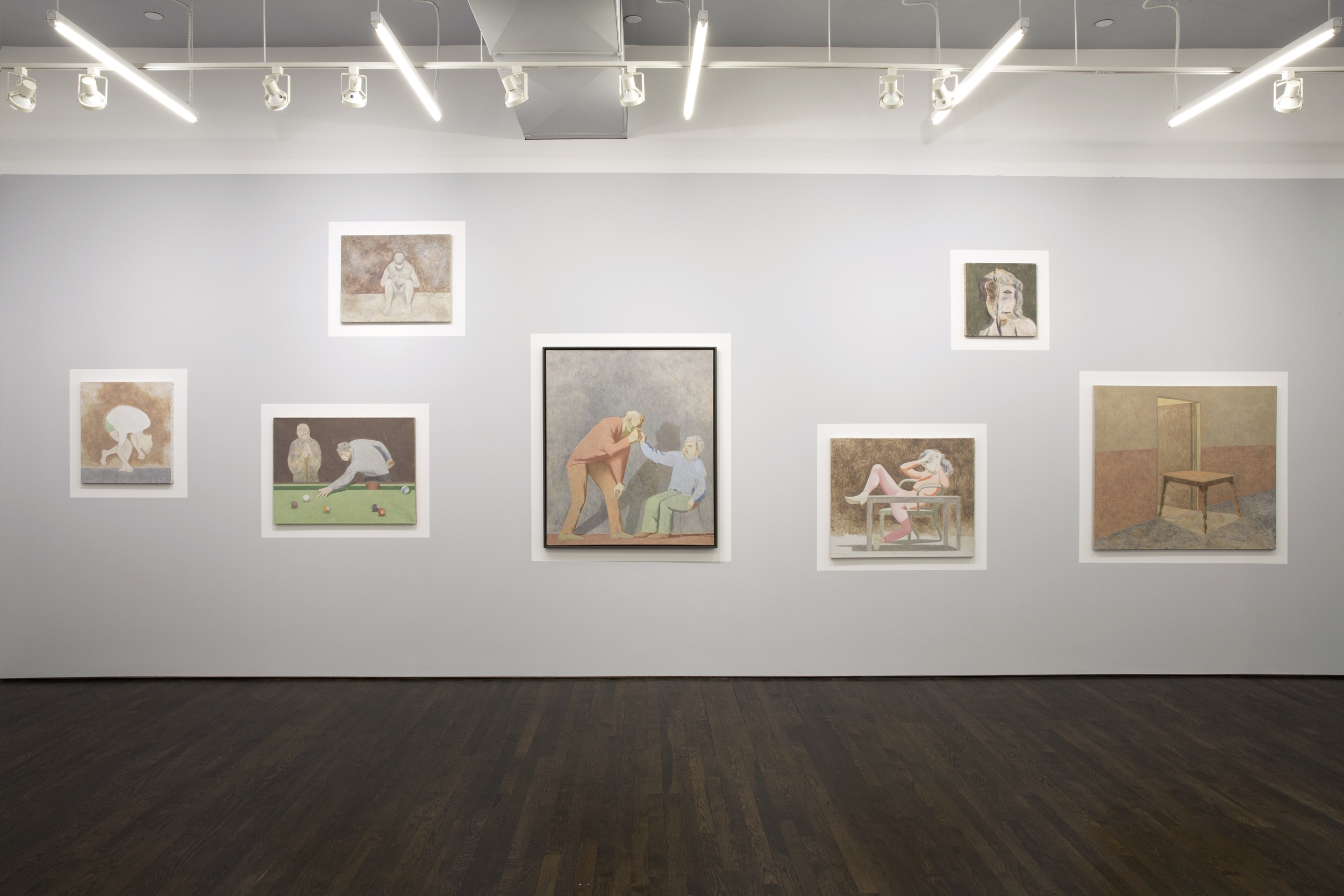
David Byrd at White Columns, January 17– March 9, 2019
Andrea Hull: Matthew, how did you get started with David Byrd?
Matthew Higgs: I first saw the work of David Byrd in 2015 at an exhibition at Zieher, Smith, and Horton Gallery in New York’s Chelsea district. David’s work was shown alongside that of Peter Gallo, an artist I had shown at White Columns in 2005. So initially, I went to the exhibition to see my friend Peter’s work and had this revelatory experience encountering David Byrd’s work for the first time. Seeing his work alongside Peter Gallo’s was important to my initial thoughts about David’s work, and somehow the context of the two artists together created a strong and lasting impression.
AH: What specifically about Peter Gallo’s work?
MH: Gallo’s work and Byrd’s work are very different, but there are some unusual biographical connections. Peter Gallo had worked in mental health institutions. David Byrd had worked as an orderly for many years of his life in a psychiatric hospital. But what I thought was most interesting about these artists is that both are painters, and both have a maverick and very idiosyncratic approach to their work and the subject of their work. There was an intense sort of atmosphere or relationship between the two artists.
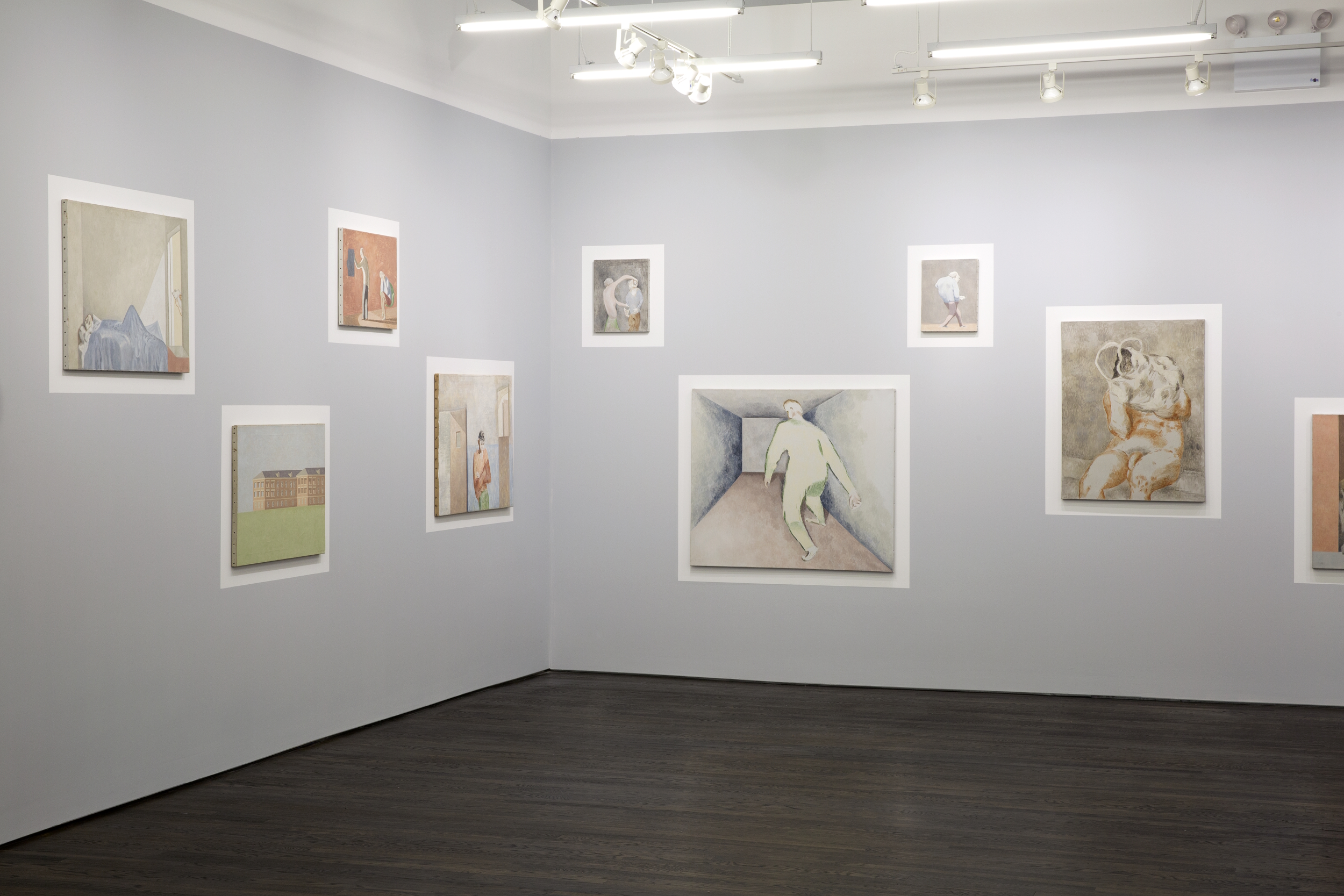
David Byrd at White Columns, January 17– March 9, 2019
AH: Why did you decide to show David Byrd?
MH: I think White Columns’ mission over the past five decades has remained consistent. One of the things that we are interested in is showing the work of artists and presenting artists’ ideas around which consensus has yet to form. Sometimes that means we’ll show a very young artist: the work is being seen for the first time. Sometimes, in the case of David Byrd, it’s an artist with whom the larger public is somewhat unfamiliar. There’s very little writing about his work, and the process of consensus-forming hasn’t happened yet.
What interests me about showing David’s work at White Columns, even though the artist was older and he’s deceased, is that it is largely unfamiliar and that the majority of our audience will be seeing it for the first time. In that respect, there’s an extraordinary present-tenseness about David Byrd’s work. That’s really the thing in which we’re most interested at White Columns—so it doesn’t matter when the work was made, who the work was made by, or the circumstances in which it was produced. Really, what we are interested in is introducing people to work that they are unfamiliar with, and supporting artists’ ideas that have yet to benefit from wider critical, curatorial, or commercial support.
And my understanding of David’s work, given the subject matter, especially the paintings at White Columns, which relate very much to the veteran’s hospital where he worked, is that they seem to be quite political paintings. David’s empathy for his subjects, individuals who were damaged in the Second World War, the Korean War, and the Vietnam War, aren’t typically the subjects of art. We might see them in documentary photography or documentary film, but somehow David brings an extraordinary dignity to the subjects, which I interpret as a kind of political gesture. By depicting them and making them the subject of his work, he gives them a kind of dignity and presence that they might otherwise not have had.
AH: And that is the contemporary meaning of his work?
MH: I think that’s part of the work. It seems so in the current political climate in the United States. The nature of healthcare, mental healthcare, and the pharmaceutical industry seem to be embedded in David’s work. Whether that was his explicit intention or not is another matter.
AH: What was the organizing idea behind this show?
MH: David painted for five decades, and he made paintings of different subjects. I wanted to focus specifically on works that related to his time at the hospital, which was from 1958 to 1988. This extraordinary 30-year period in his life is where, I think, as an artist, he really found his subject.
I also wanted to provide visitors to White Columns a quite focused introduction to David’s work. So rather than trying to present everything, we present a very specific group of paintings. What’s interesting to me about this group is that they were produced between 1960 and 2013, so the paintings represent a 43-year span of David’s practice. They represent not only the time he was at the hospital, but also the time after he retired and continued to paint in the Catskills. So, in a strange way, the exhibition is a mini-retrospective of David’s paintings and his approach to making paintings, but at the same time, it’s also a very specific narrative around this time he spent at the hospital.
The works are installed in such a fashion that hopefully you can read them as a kind of continuous narrative, even though it’s a narrative of our making. But there’s clearly a relationship between all the paintings. We hope the way they’re installed allows each painting to have its own kind of designated, focused space. But at the same time, there’s a relationship to its neighbors, the paintings to the left and to the right.
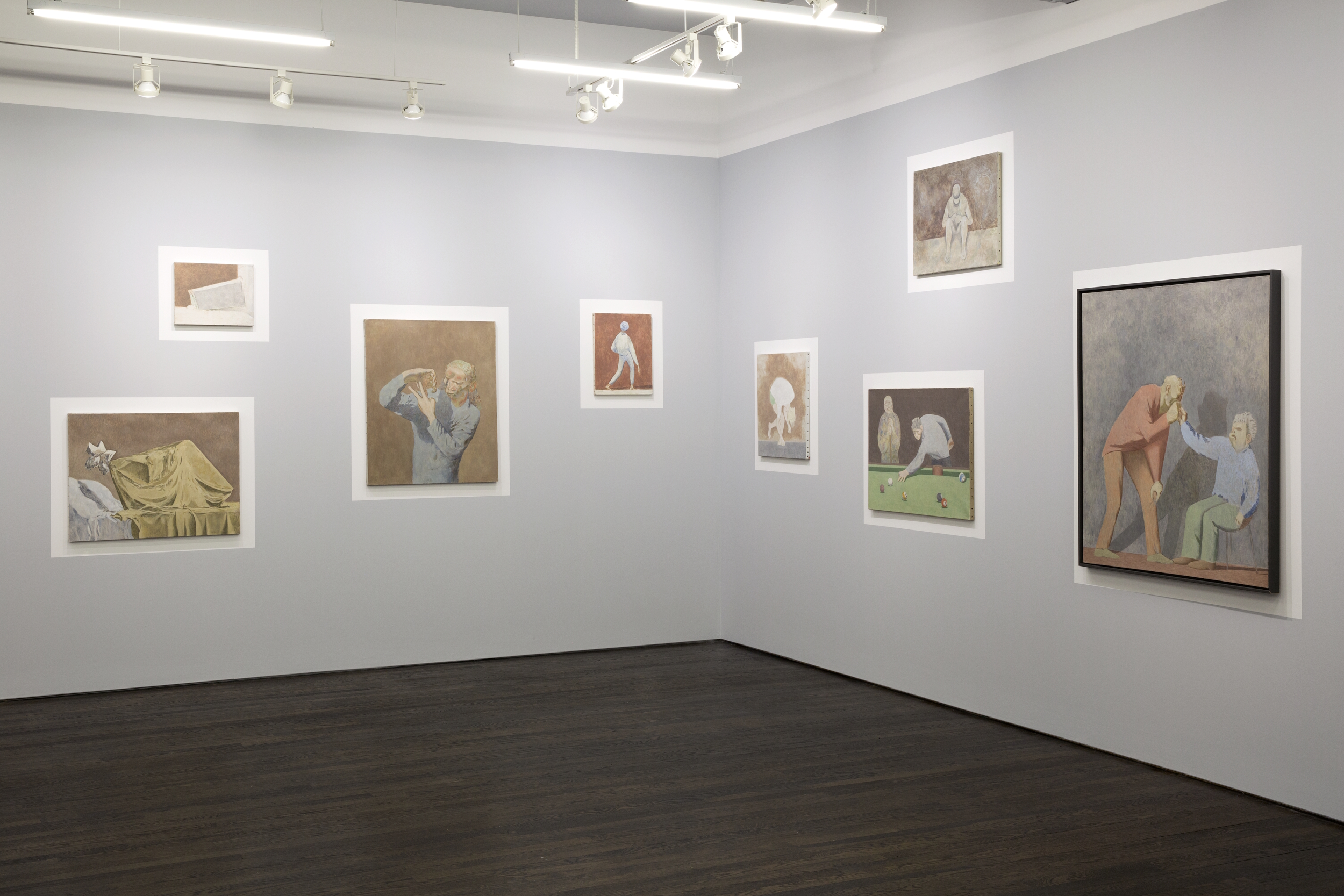
David Byrd at White Columns, January 17– March 9, 2019
AH: Are you referring to the white bands that frame the work?
MH: Yes, I haven’t done this before. I certainly haven’t seen it done elsewhere. When I started to think about how to present these paintings, what struck me about each one was that it was a completely resolved event in itself. I wanted to give each painting its own space. So how does one do that? If they were installed conventionally along white walls, I’m not sure that would’ve worked. So, I wanted to create a vignette, literally a frame for each painting, simply by painting the gallery walls gray. Then within that, I was thinking about the word “frame” and how it relates to cinema and film and how consecutive frames create a story—I was thinking about that narrative idea of framing as well. Somewhere between the idea of an individual frame to create a focused image and the idea of a continuous frame in terms of the way we think of cinema or television, that space interested me. When you look at David’s handmade book, he’s creating a narrative from his own work. That was an influence as well.
AH: Yes, David loved the cinema. Do you think he would be pleased with the exhibition?
MH: I can’t answer that because I didn’t meet David. I’m assuming, or I hope, that we’ve been respectful of the work and of his intentions. I hope we are presenting the work in an interesting light. I hope that we have created juxtapositions or conversations between paintings that perhaps he wouldn’t have made. That seems like an important part of our input into this story of David Byrd: making our own subjective connections and developing our own subjective relationships with his work. I’d like to think that he would appreciate what we’ve done. But of course, sadly, we’ll never know.
AH: Could you talk about David’s style, his vision?
MH: What’s extraordinary about his work, or one of the extraordinary things about his work for me, is this extraordinary consistency of vision. There’s also this extraordinary material consistency. So, what’s interesting in this exhibition at White Columns is that it’s very hard to distinguish which is a painting from 1960, which is a painting from 1976, which is a painting from 1990, or from the early 2000s. The paintings don’t seem to announce their age. There is a consistency of thought, intention, and vision. For me, that’s extraordinarily unusual. Also, I think his palette is unusual. It seems to relate to his interest in European painting as a younger man. It doesn’t necessarily seem to relate to American painting of a similar period, or the period that David was working in. What is amazing is that even if you’ve not seen that much of his work in person, you can identify a David Byrd painting immediately.
AH: So how do you recognize a David Byrd?
MH: All those qualities I mentioned—the subject and the way it's painted, a dry approach to brushwork and mark-making, the palette—there’s just a way of seeing the world that’s his. Certainly, within the paintings themselves and especially the paintings of the hospital, he creates a sort of stage within the paintings in which the patients, the subjects, act out their lives and their roles. In that sense, the paintings seem quite theatrical to me. There’s a lot of architecture in the painting, suggesting a beyond. Often, there’s kind of a proscenium-like space created within the paintings themselves. So, I think all these things are signatures within his work and become more recognizable the more opportunities you have to spend time with it.
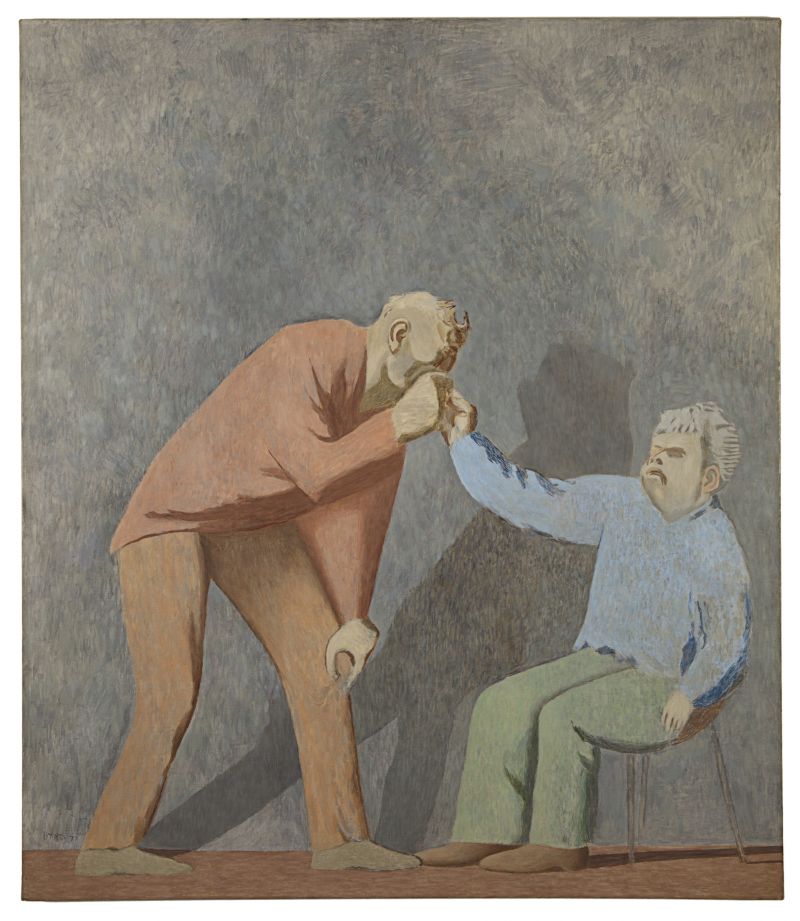
AH: What do you want to say about Smokers?
MH: Well, I love this painting. This painting behind me, Smokers, is from the mid-1970s, during the time when David was working at the VA hospital. One of the things that felt important to me with the exhibition was that the paintings made during his time working in the hospital are represented as well as works made after he retired, where he’s really painting from his memory of his experience there. The two bodies of work have quite different characteristics, in the sense that one is observed and related to the daily routines and reality of his life at the hospital. And then the second body of work after 1988 relates to his memory of that time. I think they’re different things. When someone gets a chance to organize a retrospective of David’s work and looks very carefully at the work and the dates they were made, that threshold of 1988 will be very important for how we look at, think about, and understand the paintings.
I think that Smokers is an important painting from the time he was at the hospital. It speaks to the idea of dignity and empathy for the subjects because it’s clearly just two individuals, one of whom is lighting his cigarette from the other person’s cigarette. This very small gestural connection between these two people creates a kind of humanity in the work and the image. And, of course, it’s an extraordinary incidental scene of no real significance. I think his ability to imbue these small interactions between human beings is very important.
In the artist statement David wrote later in his life, he talked about why he painted the people at the hospital in biographical and autobiographical terms—he felt that by making these paintings, it might help him with his interactions with other people. That seems to me an extraordinary reason to make art, one that you really do not hear articulated very often. I would imagine it’s quite a universal idea, which is to establish a connection. But in Byrd’s case, it wasn’t necessarily a connection to an audience for his work. It was very much for himself, to allow him to function in a different way, a better way, as a human being. So that struck me. This painting seems to contain some of those thoughts and ideas.
Then again, the ground in the painting, which is an important aspect of Byrd’s work, is the stage that he creates within the painting on which his subjects act out, behave, or take on their respective roles. I think they’re really another remarkable element of his work, both formally and psychologically. It moves them out of the documentary, and away from realism. It moves into this idea of theater, which I think is quite important in the work too. It just happens that the theater was a hospital and that the actors were the patients, his subjects.
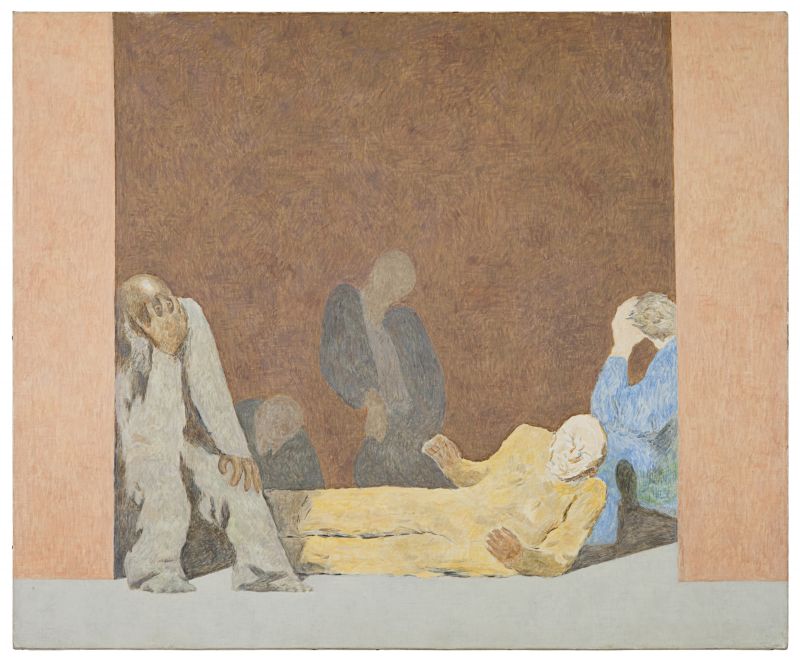
AH: Well, hospitals have theaters, you know? And what about this one, Alcove?
MH: This is a painting I saw in the exhibition where I first saw David’s work at Zieher, Smith, and Horton. The title of the painting seems very benign, but the subject of the work is clearly quite intense. It shows these groups of individuals. Once you are aware of the circumstances of where they were—a psychiatric hospital—you also understand that they are veterans who’ve been in a war or who’ve been damaged as a result of their time spent in the military. It starts to take on other connotations and narratives. The figures themselves are sculptural. They’re not specific. It’s very hard to identify them as individuals. It seems to me that David Byrd is speaking to us about much larger social and human conditions. That is a recurring theme in the work, where he’s making portraits of people who, obviously, in real life were specific people, but when they’re translated into David’s paintings, they become much more general and universal. One of the extraordinary qualities of his work is how it resonates with people. There is a universality to his thoughts, to his vision, and to his way of representing the world around him. You are no longer on a specific ward in a specific hospital at a specific time. You are really in a psychological and emotive space. That is eternal, I think.
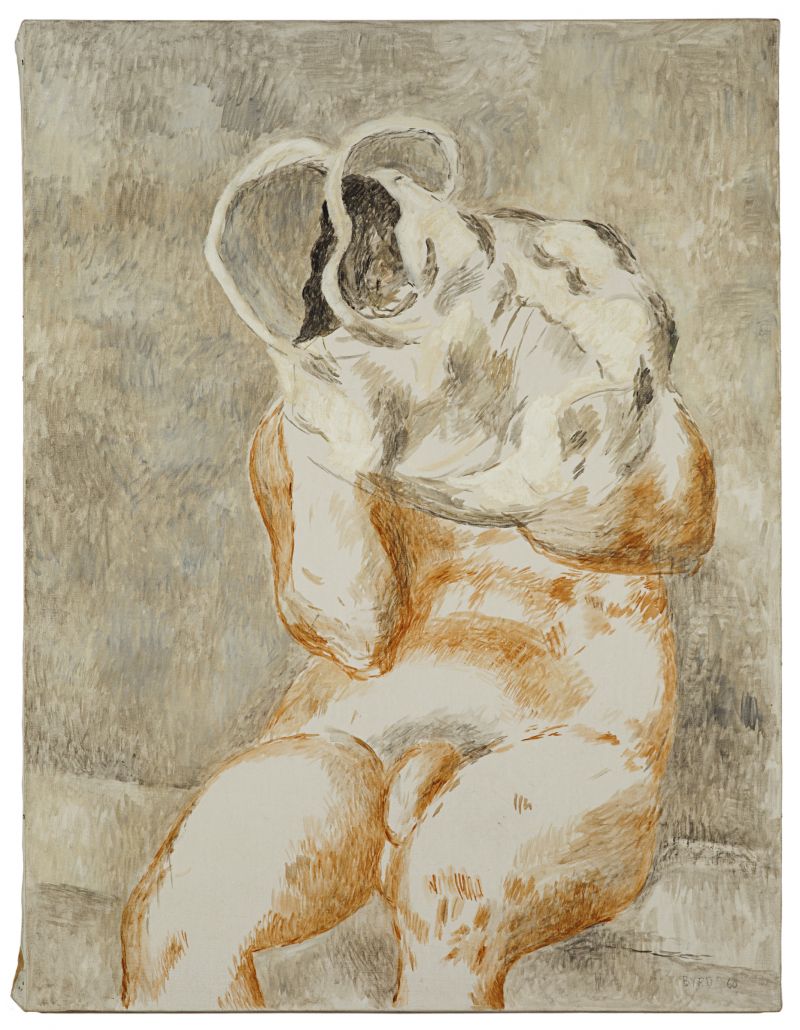
AH: What are your thoughts about the painting Putting on Top?
MH: This is one of the two earliest paintings in the White Column’s exhibition. I think it’s from 1960. David started working at the hospital in Montrose, NY, in 1958, when he would have been in his early 30s. So, he’s a relatively young man, starting to find his way as an artist. Through the two years that he had just spent at the hospital, it’s clear that the hospital, his relationship with the hospital, the life of the hospital, and what the hospital stands for are really becoming the subject of his work, and will be its subject for the rest of his life in one way or another. I think this is also the beginning of David starting to witness things, to observe things that, for the most part, would’ve gone unnoticed by pretty much everyone else.
I’m assuming that this is one of the patients struggling to take off or put on an item of clothing. It looks like a vest. In other paintings in this exhibition, David also made the patients interact with their bed clothes, for example. There are paintings of individuals trying to put on their clothes. My guess is that in his role as an orderly, part of his job would have been to help them deal with what should be mundane everyday tasks, which for them could have been complicated, problematic issues to wrestle with. I think this painting is a great example of David Byrd beginning to understand his art, beginning to understand what he is trying to do with his art, and beginning to find his subject. I believe that this is largely unique in the history of art, that somebody would spend 30-odd years of their life in a profession, and that profession actually becomes the narrative of their art. I can’t really think of another example, but I’m sure there must be one.
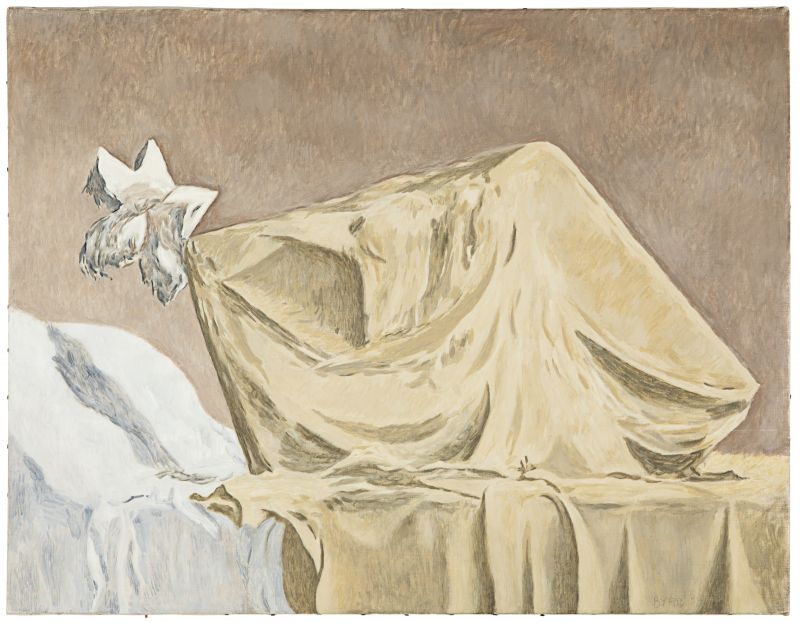
AH: What about Awoken Person?
MH: A miraculous part of his art, given the subject matter, is the extraordinarily intense reality of a psychiatric hospital and the individual and collective lives of everybody involved with the hospital. You’d imagine, or you could imagine, that the paintings themselves would be depressing. They would be dark. There would be a lack of optimism in the work. Yet somehow, David miraculously eschews all those things. The paintings are filled with light, and they’re filled with a kind of grace and humanity, and even optimism.
In some paintings, and this is a great example, I think he somehow imbues a playfulness into a situation or a scene where it might not have been present. In this case, as far as I understand, it’s a patient in their bed on a ward, underneath their bed clothes, creating a form, a sculptural form. These sculptural forms between patients and their bed clothes recur throughout Byrd’s work. There’s this strange object here that, to me, feels like a Mylar balloon, but I’m not sure what it is at all. It’s one of his more mysterious paintings.
Given his age, the fact that he was in the military during the Second World War, and that he was exposed to European painting, Byrd has some legacies of surrealism in his work that are not always strongly articulated. This painting would be one that subscribes to that idea or thought.
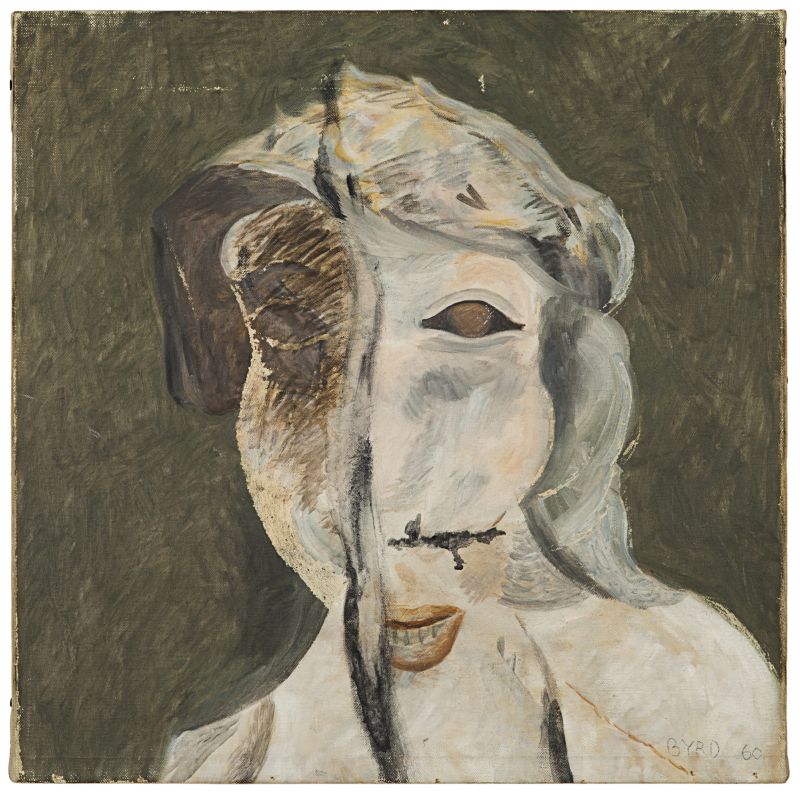
AH: Fantasy seems unusual for David Byrd. What’s going on here?
MH: The painting above me is another painting from 1960. Again, it’s very early in David’s time at the hospital. It’s quite an anomaly as a painting in terms of the group that we have at White Columns. It seems to be different formally, emotionally, psychologically, and compositionally. It’s certainly darker than most of the paintings on view here. But again, I think it’s an important painting for this exhibition because we hope it addresses the trauma of the Second World War and the legacy of that trauma on individuals, in this case David personally, who served in the military.
The patients and the staff that he encountered at the VA hospital were also dealing with the legacy of war. Again, the painting is connected to European painting from the early part of the 20th century. I think again about surrealism and that idea that a portrait is kind of a mask that recurs in David’s work, where the individuals depicted are often not recognizable in the sense that they don’t appear to be attempts at realism. He’s much more interested in conjuring up an image that speaks more universally, in a more complex way. This is more of a psychological portrait of an individual than a depiction of an individual.
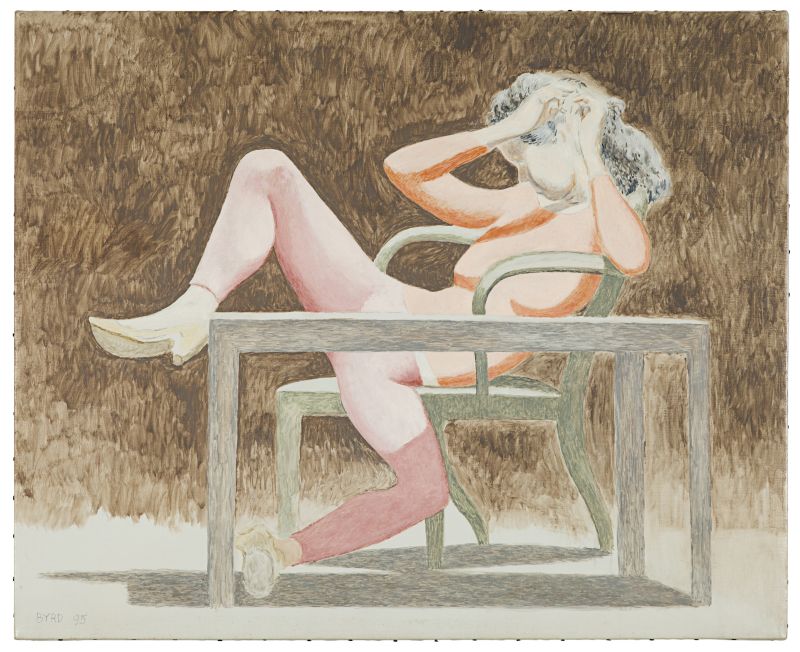
AH: How about the painting Fixing her Hair?
MH: As I mentioned before, the space that David Byrd creates in his work is a very theatrical space. He creates these stages in which his subjects, regardless of who they are, act out and behave. This seems to be an example of that, with this painting of a woman that is extraordinarily stylized. It isn’t immediately apparent that this is a hospital painting, but it is. It’s an image or a scene that he saw at the hospital. Through his translation of that experience into painting, other things started to happen. A lot of those other things interested him as a painter. He’s no longer an orderly observing things in a hospital. He’s not a documentarian. He’s really thinking about how he can translate that experience into a form that is legible to other people without being prescriptive or didactic.
That’s one of the extraordinary things about these works, given the subject matter and how we’ve seen people in psychiatric hospitals depicted in cinema, journalism, photography, and so forth. There’s always a very didactic image. I think what’s amazing about David Byrd’s work is that he avoids that almost entirely. There’s nothing didactic or prescriptive about how he interprets this world, this milieu, or this context.
This painting is a great example. If you saw it without any prior knowledge of its maker, its circumstances, or its subject, it would be very hard to arrive at a specific understanding. That’s what I like most about this painting. It seems to be free, in the sense that it seems unburdened by the gravity of what it actually depicts, which is a traumatized or traumatic individual. Again, it goes back to this extraordinary empathy for other people that reoccurs in Byrd’s work. Of course, even within that is a great paradox, because, as I understand, David was a somewhat reclusive person. This idea of empathy for others and his interest in painting as a way for him to think about his interactions with other people give a degree of poignancy to the work. I can’t really think of an equivalent for it. It’s unprecedented, the degree of his empathy for his subject.
An unusual quality about Byrd's work is that when people see it for the first time, it appeals to everyone. Everybody who sees the work finds something in it that speaks to them. That really isn’t the case for the majority of art. Somehow, not by accident, of course, because he made work for 50 years, he obviously understood what he was doing. But somehow he managed to find this extraordinary universal language that was rooted in a very specific, autobiographical narrative that was exclusive to him. I think it is miraculous that he could turn his personal, private experience of life into something that resonates with everyone.
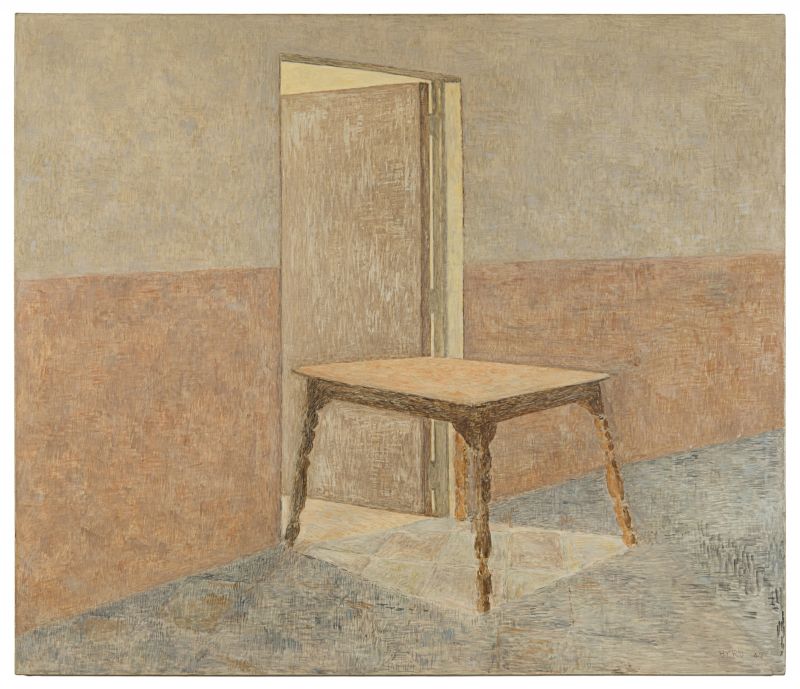
AH: Table by Door is the final painting in the White Columns show. Why did you end here?
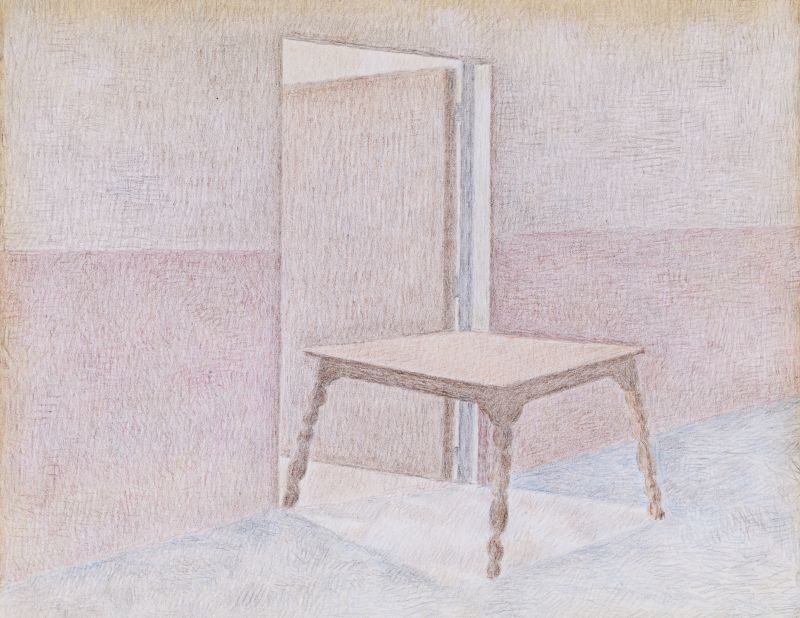
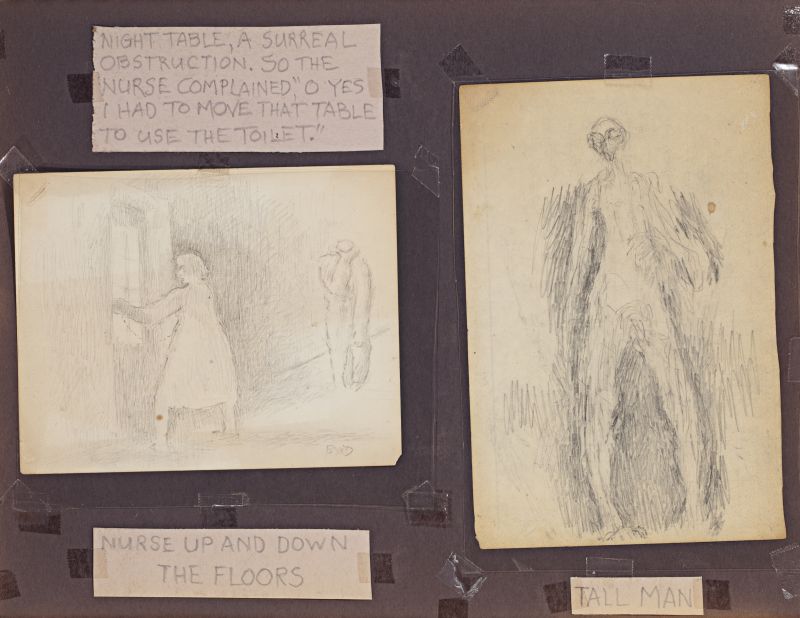
MH: I installed Table by Door as the final painting for a number of reasons. Along with the painting of the hospital itself, which shows the architecture of the place where he worked, it is one of the few paintings that doesn’t include a human subject or a recognizable human form. David made a maquette for a book that looked back and considered his time at the hospital between 1958 and 1988. There’s a drawing of this painting in the book, along with a short note that describes the scene which I would otherwise not have been privy to. As I understand, one of the patients in the hospital on the ward would move this table and block the entrance to the bathroom. Then it would be someone else’s responsibility—a nurse, or, in fact, David’s—to put it back where it came from. This repeated behavior, these repeated interactions between the patients, the orderly, the nurses, and the space itself—the architecture of the hospital— and this object—the table—strike me as a very beautiful and poetic moment in the daily routines that David experienced at the hospital. That he chose to make a painting of it speaks volumes to his extraordinary powers of observation and empathy, and his understanding of his situation and his circumstances.
Again, to go back to that text, where he talks about his interest in how the patients coped with the staff, I thought it was an extraordinary way of thinking, because you wouldn’t necessarily think that the patients would be coping with the staff; you’d think that the staff would be coping with the patients. I thought it was an extraordinary reversal because it really puts the emphasis on the patients. The staff were there to help and serve the patients, not the other way around. Somehow, in this seemingly innocuous painting of a table in a doorway, it opens up into this narrative about time spent in a place with other people, and the life of the hospital is somehow embedded in these objects. It’s also an extraordinarily beautifully painted painting. There are a lot of technical things that are unique, or at least idiosyncratic, to David’s work that are very evident in terms of the color, the mark-making, and the space he creates within the painting itself. This painting seems almost emblematic of his work. Albeit, it’s missing the central element of his work, which is the figure.
| Pages from David Byrd’s book, Montrose VA 1958-88, circa 2002 |
|
AH: In closing, any final thoughts about David Byrd and his artistic legacy?
MH: I think one of the important, interesting, and compelling things about David is his autobiographical narrative. There’s something compelling about the idea of David Byrd as an artist because he produced the work over a period of 50 years. He worked relatively in isolation. He showed the work to very few people. In a strange way, he becomes almost the perfect sort of romanticized idea of the artist—an individual who is compelled to make the work for himself. The work is produced on his own terms. It isn’t produced for galleries, exhibitions, or the market. In that sense, David Byrd subscribes to sort of the classic image of the outsider artist, even though he clearly isn’t an outsider artist. For a lot of people, that’s quite an appealing idea of the artist, i.e., someone who is unaffected by commerce, by fame, celebrity, or notoriety. That is the artist, who simply makes the work for what people might call the right reasons.
I think David Byrd is a much more complicated individual and artist than that sort of clichéd idea of an artist. There are things about his life and the circumstances in which the work was made that are unusual. It's especially unusual in the second half of the 20th century and the beginning of the 21st century. He was exposed to the world. He was exposed to very different aspects of life. He was exposed to high culture as a younger man at the end of the Second World War, and he had studied art. He doesn’t really satisfy any of the conventional ideas that we might have of an outsider artist, yet at the same time, his work has a very singular poetry. His idiosyncratic nature seems to be untroubled by external influences. Again, I don’t think this is true, but I think it’s a sort of magic, almost a slight of hand, that Byrd manages to pull off in the work where he creates a completely convincing, self- contained world through his art. And for that I think it is unusual, and for that reason there’s something extraordinarily compelling about his work, even on first encounter.
Certainly, the response we’ve had here at White Columns from visitors to the gallery has been pretty consistent: everybody finds something in the work that speaks to them. This is one of the amazing qualities of David Byrd’s work, outside of and beyond what’s depicted, how it’s depicted, and so on. As more people get to know Byrd’s work, as the exhibition at Anton Kern opens later this month, as the work gets published and seen more widely, hopefully someone will eventually organize a full-scale retrospective and publish a monograph that will fully investigate and interrogate his life. I think a much clearer picture of David Byrd will emerge.
For the moment, at least in this nascent time for his work, it is interesting that we don’t have all the answers. Not everything is resolved, and not everything is clear. The ambiguity that exists in the work is allowed to maintain its place too.
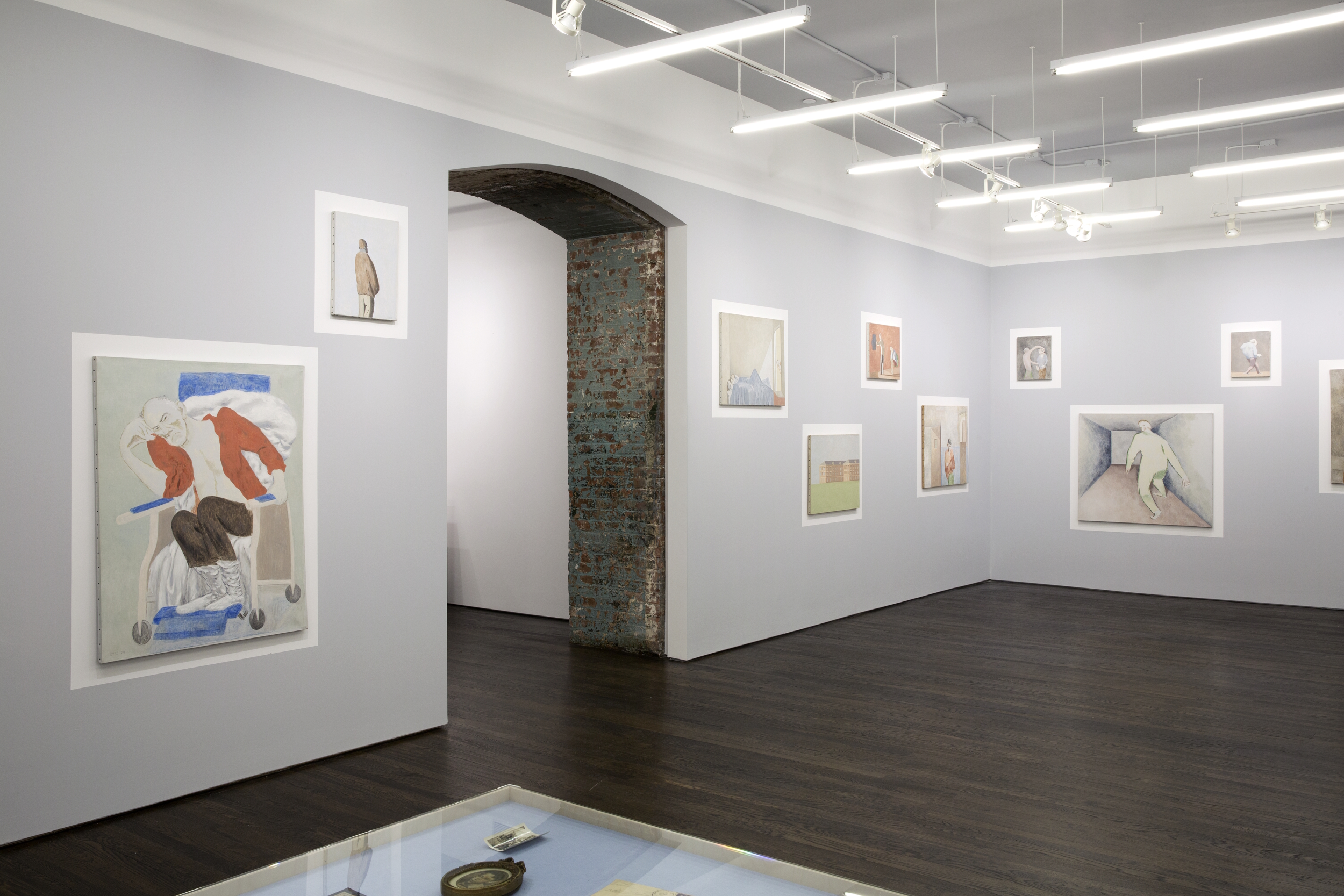
David Byrd at White Columns, January 17– March 9, 2019
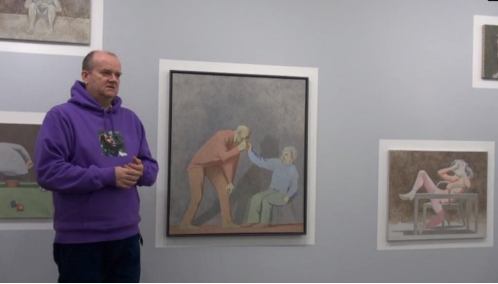 Matthew Higgs, Director/Chief Curator at White Columns, 2004-present.
White Columns was founded in 1970 by a group of artists including Jeffrey Lew and Gordon Matta-Clark as an experimental platform for art. Originally located in SoHo (and known as the 112 Workshop/112 Greene Street), the organization was renamed White Columns when it moved to Spring Street in 1980. In 1991 White Columns moved to Christopher Street in the West Village, and in 1998 the gallery relocated to the borders of the West Village and Meat Packing District. In April 2018, White Columns re-opened in a new location at 91 Horatio Street adjacent to the new Whitney Museum of American Art and The High-Line.
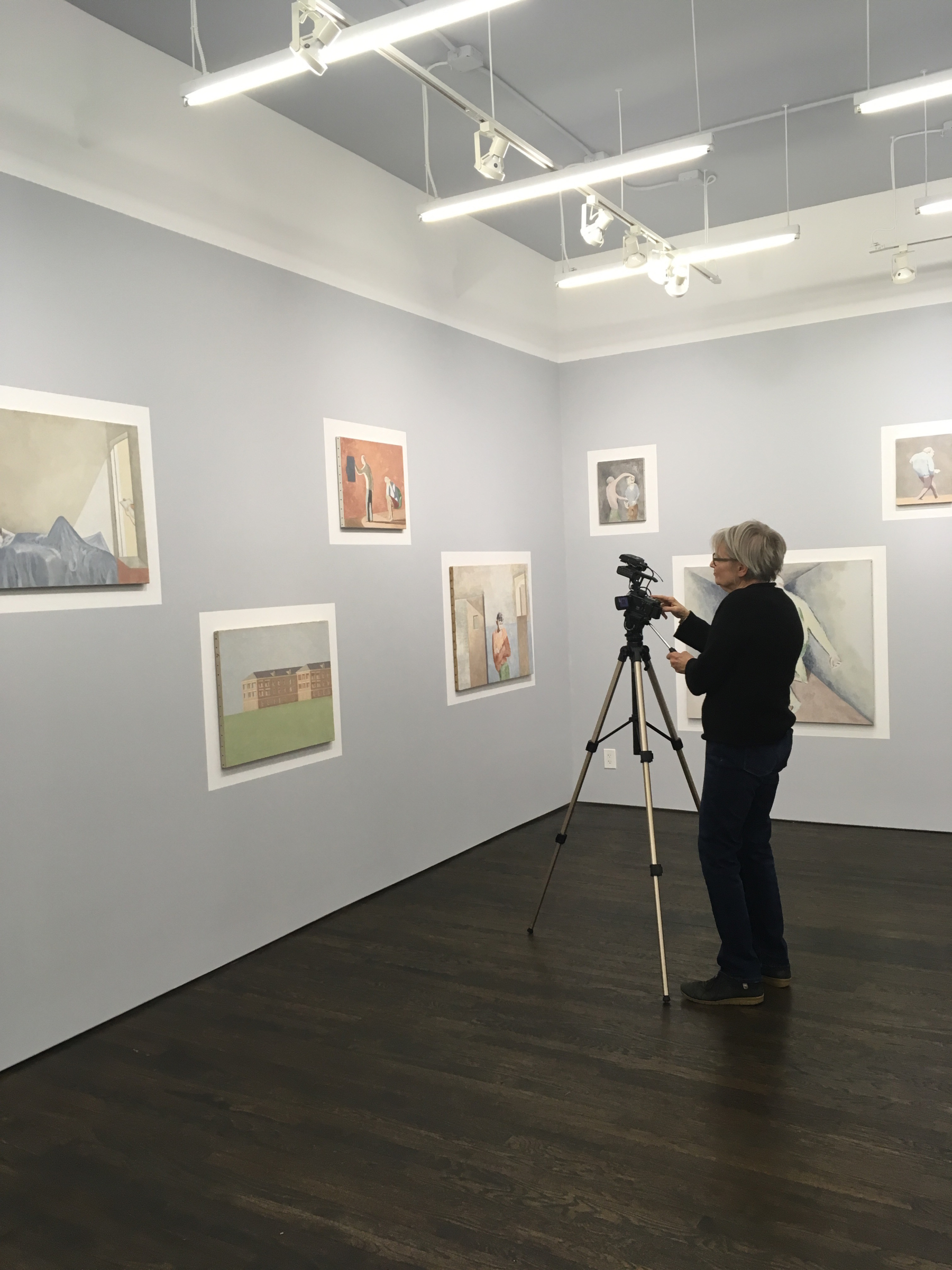
Andrea Hull, Film and video maker.
Her work has been exhibited at MoMA, the Corcoran Gallery of Art, the Hirshhorn Museum and Sculpture Garden, the Collective for the Living Cinema, Anthology Film Archives, the Tucson Museum of Art, Film at Lincoln Center, and is included in the NY Public Library Dance Film Collection at Lincoln Center.