
Scroll Flask and Hand
By Merlin James
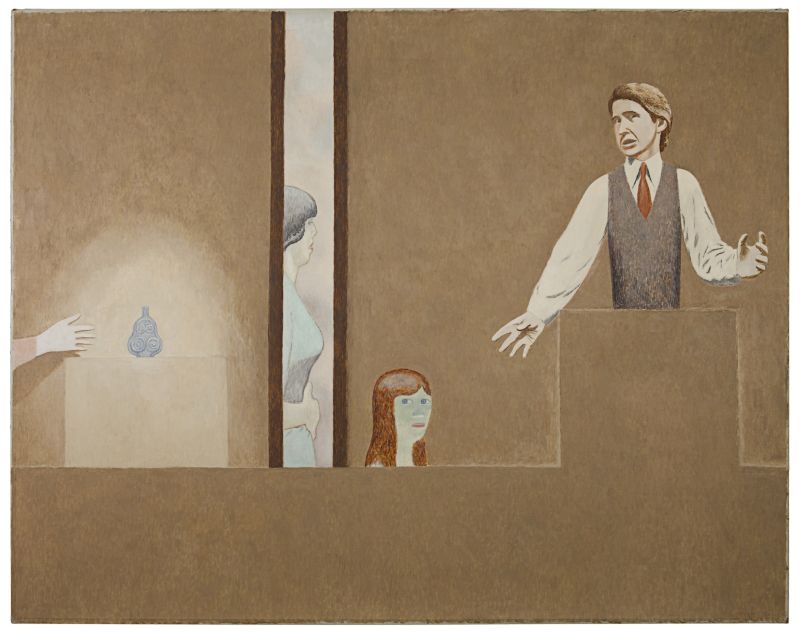
Behind the scenes, out of mind, a woman queasily presses a hand to her stomach, down towards her womb. She may be sick, maybe with anxiety, apprehension.
Up front, to the right, a male figure in businesslike, professional outfit, stands behind a podium. He’s presumably addressing an audience, one that includes me. His expression is cagey, calculating. His mouth is open as if speaking.
Between the man and woman, central in the picture, but lower, as if seated behind a counter, a girl half turns to meet my gaze. I see only her head, neck and a hint of shoulder. Her expression could be complicitous, or reproachful. She’s saying nothing. Yet she’s sharing something with me, an acknowledgement.
Over to the left, on another podium block, stands a small bottle. A narrow-necked, modestly ornate flask, seemingly made of bluish glass. It suggests a vessel on an altar, or on a monument, a tombstone. The flask has a radiant, mystic aura. Further left again, from out of frame, a hand reaches towards the bottle, as if to snatch it away, or as if having just placed it.
The painting overall presents a tableau, almost a diagram, of human interaction, perhaps an allegory. But what’s going on exactly? What folk are these? Are they indeed real people (whatever that might mean), and what is the nature of their relationships? On some schematic level they could be a family: working guy, worried wife, child growing up between them. But this is hardly a conventional domestic group portrait. Other things are happening – a process, a ritual.
The male figure comes across as a master of ceremonies. His arm gestures and facial expression would seem to suggest some kind of weighing-up. He could be an advocate or judge. Is the girl a defendant, or witness? A ward of court?
I think of courtroom pictures by Daumier.
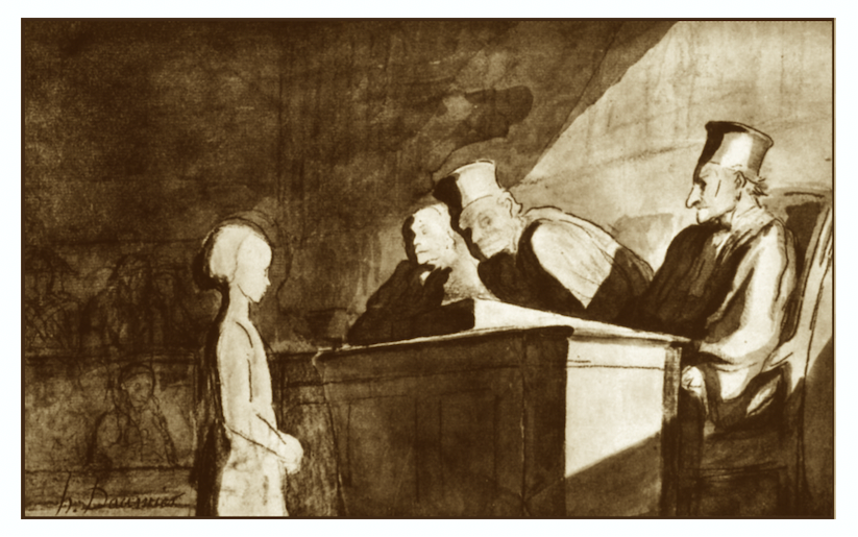
Honoré Daumier. Testimony of a Minor, c.1860–65. Ink and gouache, 21.5 x 34.5 cm. Ny Carlsberg Glyptotek, Copenhagen.
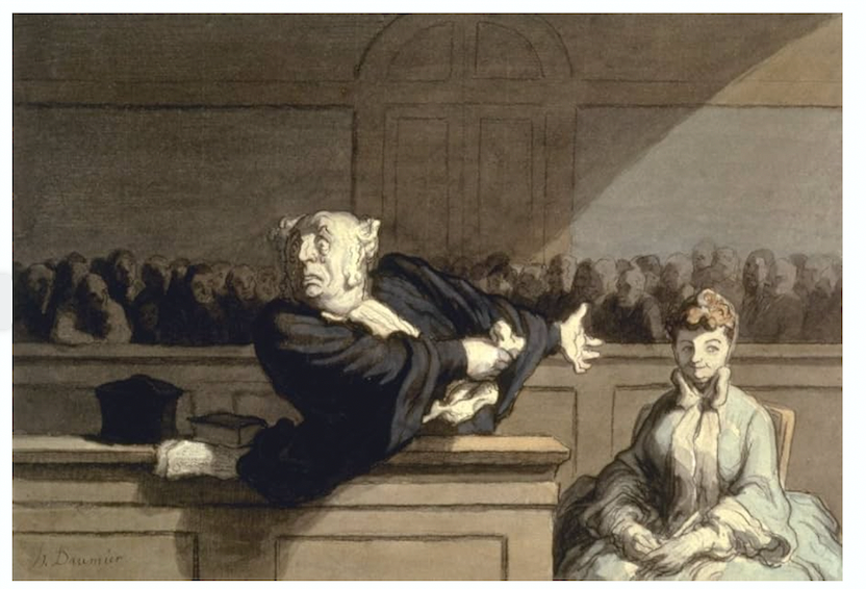
Honoré Daumier. Counsel for the Defense, c.1862–65. Crayon, ink and watercolor, 20.2 x 29.2 cm. National Gallery of Art, Washington, D.C.
Then again, could this guy be a politician or evangelist? A bartender, a conjurer, hypnotist, quizmaster or game-show host? His right hand reaches down towards the girl as if he speaks about, or for, her. Their dynamic has about it something of a ventriloquist and dummy. But which is which? Both appear slightly unnatural, artificial. The girl’s head could be ceramic or papier-mâché, with its milky highlight on the hair and its odd polychromy. The man appears to be joined at the waist to the architecture around him. His torso is strangely rectilinear (or cylindrical), symmetrical and central to the podium as if he were an extension of it. His head torques stiffly. He is puppet-like, a store-front mannequin, a Jack- in-the-box.
There is some correspondence or equivalence, meanwhile, between him and the bottle opposite, both set frontally on similar platforms. The man is object-like while the bottle has a certain anthropomorphic presence. It sits, Buddha-ish, with passive charisma, while the man is animated; but they counterbalance each other in the composition. And the small flask’s unassuming self containment, its integrity, gently outweighs the man’s articulate sophistication.
I’m also aware, however, of the flask’s proximity to, and its tonal and formal kinship with, that easily overlooked woman in the background. It shares the undulating outlines of her bosom, her hair-do, her facial profile. It has a femininity about it. It looks like a perfume bottle. Its ornamentation and outline suggest hips and breasts, like an ancient ‘Venus’ figure or fertility fetish. Womb-like (though evoking other organs too – brain, lung, heart), its affinity is with the female.
.....
Perhaps now is the time to acknowledge that what this painting depicts ‘in fact’ (again, whatever that means), is an auction sale. The man is an auctioneer. The girl is a clerk – recording bids, keeping a tally – and the disembodied hand is that of a porter who brings the lots to the block. One probably deduces all this even without knowing that the artist who made this work, David Byrd, was a collector of vintage bottles and a regular at bottle sales. He made several paintings which more explicitly represent these events and environments.
But it’s right not to have jumped to this reading too quickly, prompted by ‘background’ information. After all, Byrd’s title Scroll Flask and Hand does not give the game away. And he leaves invisible a key element that would help elucidate the scene – a gavel in the auctioneer’s hand.
So it’s important we acknowledge the painting’s openness to alternative readings. In a sense it is indeed a quiz, a guessing game for the viewer, and one in which the top prizes are won not by just identifying the scenario – problem solved, game over – but rather in divining deeper metaphoric mysteries in the painting. And such resonances should be entertained even after we’ve identified the nominal subject.
A transaction is occurring, certainly. A change of hands, passing from left to right, leading even to an implied hand-over to me. (I only have to raise my own hand, to bid.) And yes it’s the bottle that is the property up for exchange – not the girl. She’s not a slave; only maybe a wage slave to her office job. Yet we can’t help being reminded that people too can be treated as possessions.
Conversely, material possessions can be humanised. What kind of value, exactly, does that humble flask have? What gives it its glimmer of glamour, makes it an object of desire? What mixture of aesthetic and historic virtue makes people wish to acquire it? Does it have special associations, ‘sentimental value’? Is it an heirloom? How does human attraction and affection for physical objects equate to our related feelings towards living beings? Do artefacts stand for or symbolize persons? (David Byrd lived alone. He loved old bottles, they say. He had a passion for them. His collection is now largely dispersed.)
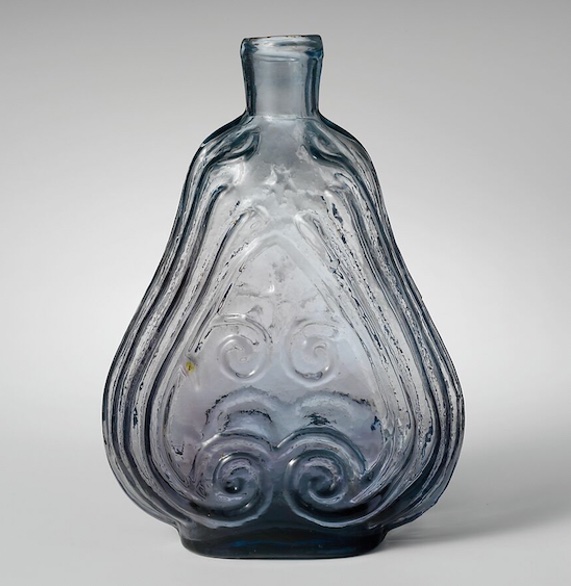
Scroll Flask, American (Pennsylvania), c.1840-50. Metropolitan Museum of Art, New York.
There’s an ekphrastic reflexivity in all of this, as well. The bottle is a work of art within another work of art. What is true of it is also true of the painting that depicts it. I love this painting, I say. I love its touch and tenor, its unnamable hue between beige and clay, the pulse of brushstrokes across its dense but breathing surface. To me, it’s alive.
.....
Of course, nothing of the elusive and allusive semantic network suggested above has necessarily been built in to the painting intentionally. Indeed, the work’s lasting fascination is all the greater for its not being an emblem of meanings deliberately encrypted by the artist.
A telling comparison is with The Shadow of the Hand (1929), a painting by Byrd’s teacher in the late ‘40s, Amédée Ozenfant.
![Certainly there’s an influence: geometric pictorial architecture; basic ‘man-made’ objects; the relation of hand to manufacture; reality to image; life to art. But Ozenfant’s picture feels like a treatise, a theoretical proposition. It illustrates the pseudo philosophical pedantry of his various manifestos and statements of the early 1920s, promoting his art movement Purism: In all ages and with all people, man has created for his use objects of prime necessity which responded to his imperative needs... vases, glasses, bottles, plates, which were built to suit the needs of maximum capacity, maximum economy of materials, maximum economy of effort... for this reason [being] of human scale, harmonizing both among themselves and with man... [T]he Purist element, a bottle-element for example, ought always to embody the characteristic and invariant constants of the object-theme ... Purism would never permit a bottle of triangular shape, because a triangular bottle, which ultimately could be produced by a glass-blower, is only an exceptional object, a fantasy, like the idea behind it... Purist syntax is the application of constructive and modular means... A painting is a whole (unity), an artificial formation which, by appropriate means, should lead to the objectification of an entire ‘world’. Purism strives for an art free of conventions which will utilize plastic constants and address itself above all to the universal properties of the senses and the mind. Le Corbusier and Ozenfant, ‘Purism’, (l’Esprit Nouvel, Paris,1921). Reprinted in Robert L. Herbert, Modern Artists on Art, Dover Publications, Mineola, N.Y., 2000.](https://cdn.panopticoncr.com/davibyr001/catalogue_uploads/qyoxzbbk/The%20Shadow%20of%20the%20Hand.jpg)
Amédée Ozenfant. The Shadow of the Hand, 1929. Oil on canvas, 81.5 x 105 cm. Royal Belgian Museums of Art, Brussels.
Certainly there’s an influence: geometric pictorial architecture; basic ‘man-made’ objects; the relation of hand to manufacture; reality to image; life to art. But Ozenfant’s picture feels like a treatise, a theoretical proposition. It illustrates the pseudo philosophical pedantry of his various manifestos and statements of the early 1920s, promoting his art movement Purism:
In all ages and with all people, man has created for his use objects of prime necessity which responded to his imperative needs... vases, glasses, bottles, plates, which were built to suit the needs of maximum capacity, maximum economy of materials, maximum economy of effort... for this reason [being] of human scale, harmonizing both among themselves and with man...
[T]he Purist element, a bottle-element for example, ought always to embody the characteristic and invariant constants of the object-theme ... Purism would never permit a bottle of triangular shape, because a triangular bottle, which ultimately could be produced by a glass-blower, is only an exceptional object, a fantasy, like the idea behind it...
Purist syntax is the application of constructive and modular means... A painting is a whole (unity), an artificial formation which, by appropriate means, should lead to the objectification of an entire ‘world’. Purism strives for an art free of conventions which will utilize plastic constants and address itself above all to the universal properties of the senses and the mind.
—Le Corbusier and Ozenfant, ‘Purism’, (l’Esprit Nouvel, Paris,1921). Reprinted in Robert L. Herbert, Modern Artists on Art, Dover Publications, Mineola, N.Y., 2000.
How much less prescriptive and proscriptive and rationalized is Byrd’s attitude to his world. Here, a bottle does happen to be rather triangular, and it is decorated – uneconomically, gratuitously – to celebrate its exceptionality, to enhance the idea, the fantasy, behind it. Here the abstract geometry of pictorial architecture is peopled by enigmatic characters, living with their circumstances, the relative constraints on their freedom, their physical and emotional closeness to and separation from each other. This is not an objectified world of theoretical terms like proportion, scale, efficiency, harmony, principle, plastic constants, universal properties. It is not a world where the ellipse in a precisely half-full bottle accords perfectly with the moon in the firmament.
For sure, Byrd is attuned to pictorial rhythm and interval, as he is to colour and tone, and to the effect all these might have on our reading of imagery. But there is no ‘application of constructive means’, rather a respect for arbitrariness and contingency. Byrd has what Keats called ‘negative capability’, a capacity to accept the inexplicable, the incompatible, unlikely, uncomfortable or alien. He doesn’t seek to order or explain, to reconcile or resolve.
.....
That tolerance and sympathy of outlook is fundamental to the intensely moving works for which Byrd may now be most celebrated, those recording life at the veterans’ psychiatric hospital where he worked for three decades as an orderly. But the same compassion is there, implicitly, right across the breadth of his art, in his many depictions of everyday life. Of laundromats, of gas stations, of bars, stores, work places, gyms, boxing rings, barber’s shops and cinemas – and auctions.
The panelled and partitioned interior in Scroll Flask and Hand is not the prison-camp confinement of the Montrose VA hospital. Yet the painting has hints of neurosis – tension, depression, mania, obsession, fantasy. Those things after all, when not at a clinical level, are simply the stuff of life. As Byrd wrote in his Montrose sketchbook: ‘But if one can hold a job and raise a family, that is about what sanity is.’ The image of his own mother boxed into a booth, selling cinema tickets to feed six children, features in several of his works and haunts many more, including Scroll Flask and Hand.
But that is again to resort to the biographical. The work itself has the last word. The auctioneer, beyond all his other personae (attorney, conjurer, etc.), surely represents the figure of the artist, even an embodiment of Art itself, showing us by his gestures how art works, what art does. With his right hand he draws attention to what exists, to ontology (including that of the art object itself). He says: All this is what is.
Then with his left hand he says: And I convey all this to you.
Then with both hands he says: And I am, and you are, part of all this. We exist.
Merlin James
Glasgow, January 2024
Merlin James is a painter. He has written extensively on art in the Burlington Magazine and elsewhere. A book of his art writing is forthcoming from Art Publishing Inc., London.